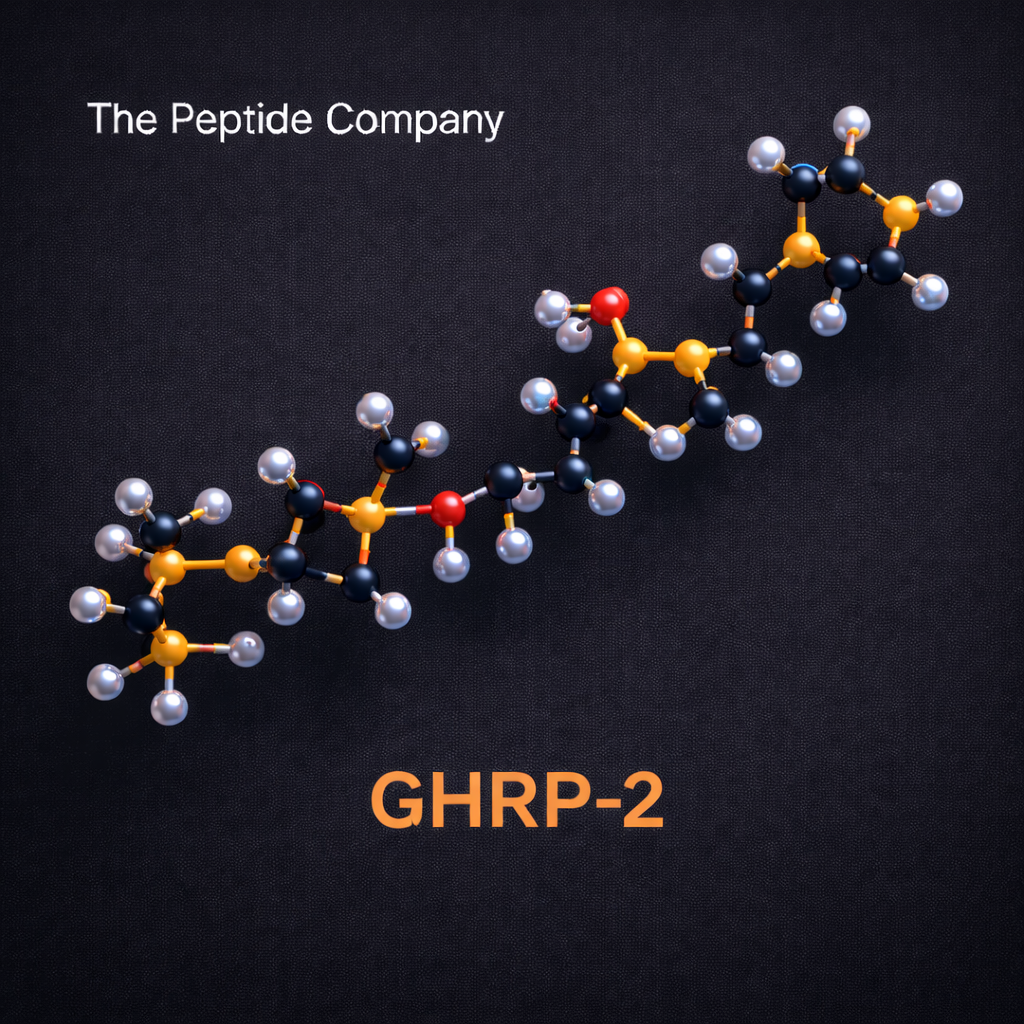
Abstract & Overview
GHRP‑2 (Growth Hormone Releasing Peptide‑2) is a synthetic hexapeptide classified within the family of growth hormone secretagogues (GHS). It is a potent agonist of the ghrelin receptor (GHS‑R1a) and has been extensively studied as a model compound for growth hormone release, pituitary sensitization, and cellular metabolic regulation. By mimicking the physiological actions of endogenous ghrelin, GHRP‑2 allows for the exploration of neuroendocrine signaling pathways that link the hypothalamus, pituitary gland, and peripheral tissues. Compared with GHRP‑6, GHRP‑2 demonstrates higher receptor affinity and more pronounced growth hormone–releasing activity, making it a valuable tool in controlled research examining somatotropic axis regulation and energy metabolism.
Molecular Pharmacology
GHRP‑2 is a hexapeptide with the sequence D‑Ala‑D‑His‑D‑Phe‑D‑Trp‑Lys‑Val‑NH₂. It functions as a selective agonist of the GHS‑R1a receptor, a G‑protein–coupled receptor expressed in the hypothalamus, pituitary gland, pancreas, and other metabolic tissues. Activation of GHS‑R1a triggers both calcium‑dependent and cAMP‑dependent intracellular cascades, leading to exocytosis of growth hormone from somatotroph cells. The peptide’s pharmacokinetic profile is characterized by rapid receptor binding and a robust amplitude of GH secretion in pulsatile models, distinguishing it from GHRP‑6 in potency and duration.
Receptor Mechanism of Action
Upon binding to GHS‑R1a, GHRP‑2 activates Gq/11 proteins, leading to phospholipase C (PLC) activation and the generation of inositol triphosphate (IP₃) and diacylglycerol (DAG). These molecules promote intracellular calcium release and activate protein kinase C (PKC), which triggers growth hormone secretion at the pituitary level. In parallel, GHRP‑2 influences other signaling networks, including MAPK/ERK and PI3K/Akt, promoting cellular survival, metabolism, and adaptive energy responses. The peptide’s capacity to modulate both endocrine and metabolic functions has made it an important compound for studying the cross‑talk between neuroendocrine and mitochondrial pathways.
Endocrine and Metabolic Regulation
Research models demonstrate that GHRP‑2 elevates plasma GH concentrations through direct pituitary stimulation and indirect hypothalamic activation. This GH release subsequently upregulates hepatic insulin‑like growth factor‑1 (IGF‑1) synthesis, driving anabolic processes such as protein synthesis, lipid oxidation, and tissue repair. Additionally, GHRP‑2 has been shown to modulate glucose metabolism and mitochondrial respiration via AMPK activation and improved substrate utilization. These effects make it a valuable agent for exploring the metabolic underpinnings of energy homeostasis in both central and peripheral systems.
Comparative Analysis: GHRP‑2 vs. GHRP‑6
While both GHRP‑2 and GHRP‑6 activate GHS‑R1a and promote GH release, they exhibit key pharmacological differences. GHRP‑2 possesses a higher receptor binding affinity and faster onset of action, leading to greater GH amplitude in dose‑response studies. GHRP‑6, however, demonstrates broader metabolic influence and mild orexigenic activity due to its secondary receptor interactions. Comparative data suggest that GHRP‑2 is more selective and potent for pituitary‑specific GH release, whereas GHRP‑6 exerts a wider systemic effect on energy balance and tissue metabolism.
Cellular Recovery and Regenerative Research
Beyond endocrine functions, GHRP‑2 has been studied for its effects on cellular recovery and oxidative stress modulation. In vitro and in vivo research models show that GHRP‑2 enhances mitochondrial membrane potential, reduces reactive oxygen species (ROS), and stabilizes cellular redox balance. Its anti‑inflammatory influence through NF‑κB pathway suppression and cytokine regulation further supports its potential as a model for stress adaptation and tissue recovery studies. These findings underscore its value in investigating the intersection between peptide signaling, mitochondrial health, and regenerative cellular mechanisms.
Summary
GHRP‑2 is a potent ghrelin receptor agonist that exemplifies the relationship between neuroendocrine signaling, energy metabolism, and cellular protection. Its ability to induce growth hormone release, enhance mitochondrial efficiency, and regulate redox balance has made it a foundational compound for research into somatotropic and metabolic pathways. By comparing its receptor bias and mechanistic profile to analogs such as GHRP‑6 and Azelaprag, researchers can gain valuable insight into GHS‑R1a signaling and its systemic implications for metabolic homeostasis.
Educational & Research Disclaimer
This article is for educational and scientific research purposes only. No therapeutic claims or usage recommendations are provided. Compounds referenced are not approved for human use and are intended solely for controlled laboratory experimentation.
GHRP-2 (Growth Hormone–Releasing Peptide-2) is a synthetic hexapeptide classified as a growth hormone secretagogue that activates the ghrelin (GHS-R1a) receptor.
GHRP-2 stimulates growth hormone release by binding to ghrelin receptors in the hypothalamus and pituitary, influencing somatotropic axis signaling and pulsatile GH secretion.
No. GHRP-2 does not contain growth hormone itself. It functions by signaling endogenous growth hormone release pathways.
GHRP-2 is studied in research settings for pituitary axis modulation, ghrelin receptor signaling, cellular recovery pathways, and metabolic regulation.
Yes. Research shows GHRP-2 can influence cortisol, prolactin, and appetite-related signaling due to its interaction with ghrelin receptors.
Yes. GHRP-2 is classified as a ghrelin receptor agonist and is often used as a model compound for studying ghrelin-mediated endocrine signaling.