
Abstract & Overview
GHRP‑6 (Growth Hormone Releasing Peptide‑6) is a synthetic hexapeptide and one of the earliest members of the growth hormone secretagogue (GHS) class. It acts as a potent agonist of the ghrelin receptor (GHS‑R1a), triggering both endocrine and metabolic responses in research models. By mimicking endogenous ghrelin signaling, GHRP‑6 provides a tool for studying growth hormone release, cellular metabolism, and tissue repair mechanisms. Its biochemical profile and receptor interactions make it an important compound for exploring neuroendocrine regulation and energy homeostasis in laboratory settings.
Molecular Pharmacology
GHRP‑6 is a hexapeptide with the sequence His‑D‑Trp‑Ala‑Trp‑D‑Phe‑Lys‑NH₂. It belongs to the same structural family as GHRP‑2, Hexarelin, and Ipamorelin but exhibits a unique receptor activation pattern. Its primary target, the growth hormone secretagogue receptor type 1a (GHS‑R1a), is a G‑protein–coupled receptor (GPCR) that mediates both calcium‑dependent and cAMP‑linked signaling cascades. Through this receptor, GHRP‑6 influences pituitary growth hormone release and peripheral metabolic responses. Studies highlight its dual capacity to activate endocrine and paracrine signaling pathways involved in cell proliferation, metabolism, and stress adaptation.
Ghrelin Receptor Signaling Pathway
GHRP‑6 acts as an exogenous ligand for GHS‑R1a, a receptor expressed predominantly in the hypothalamus, pituitary gland, pancreas, and gastrointestinal tract. Upon binding, GHRP‑6 activates Gq/11 proteins, leading to phospholipase C (PLC) stimulation and the generation of inositol triphosphate (IP₃) and diacylglycerol (DAG). This signaling cascade increases intracellular calcium concentrations and activates protein kinase C (PKC), which promotes vesicular growth hormone release from pituitary somatotrophs. In addition to this canonical pathway, GHRP‑6 signaling interacts with MAPK/ERK, PI3K/Akt, and AMPK networks, linking the peptide to broader effects on metabolism and mitochondrial regulation.
Endocrine and Metabolic Research
In controlled studies, GHRP‑6 has been shown to stimulate pulsatile growth hormone secretion, elevating circulating insulin‑like growth factor‑1 (IGF‑1) concentrations through hepatic synthesis. These responses make it valuable for studying somatotropic axis regulation and growth‑related signaling. Beyond endocrine actions, GHRP‑6 influences glucose metabolism, fatty acid oxidation, and mitochondrial biogenesis through AMPK activation and improved cellular energy utilization. Research models indicate that chronic GHS‑R1a activation may contribute to enhanced metabolic flexibility and adaptive responses under nutrient stress conditions.
Cellular Regeneration and Stress Response
GHRP‑6 has been used to study cytoprotective and regenerative mechanisms in a variety of tissues, including skeletal muscle, liver, and neural systems. Its signaling activity modulates apoptosis, autophagy, and oxidative stress pathways, leading to reduced cellular injury and improved tissue repair. GHRP‑6’s influence on mitochondrial integrity and reactive oxygen species (ROS) control highlights its relevance in studies of cellular longevity and metabolic adaptation. Additionally, its engagement with the ghrelin receptor system contributes to anti‑inflammatory signaling through NF‑κB inhibition and cytokine modulation.
Comparative Signaling: GHRP‑6 vs. GHRP‑2 and Azelaprag
While GHRP‑6 and GHRP‑2 share similar receptor targets, they differ in potency and receptor bias. GHRP‑2 demonstrates higher affinity for GHS‑R1a but shorter duration, while GHRP‑6 offers a broader receptor activation profile with enhanced metabolic modulation. Compared with Azelaprag—a non‑peptide ghrelin receptor agonist—GHRP‑6 represents a classic peptide model for studying ligand‑receptor conformational signaling and the kinetics of GPCR activation. Together, these compounds help define how different molecular frameworks influence GHS‑R1a‑mediated pathways and downstream gene expression.
Research Applications in Metabolism and Growth
Due to its dual anabolic and metabolic actions, GHRP‑6 serves as a model compound for studying growth hormone physiology, energy metabolism, and cellular recovery mechanisms. In muscle and hepatic tissue, it promotes protein synthesis, glycogen replenishment, and oxidative balance. Studies also investigate its effects on circadian rhythm regulation, appetite control, and gut‑brain axis communication through peripheral ghrelin receptor activation. These findings position GHRP‑6 as a versatile research tool for examining interconnected neuroendocrine and metabolic networks.
Summary
GHRP‑6 is a synthetic peptide that continues to play a significant role in ghrelin receptor and growth hormone secretagogue research. Its receptor interactions extend beyond GH release, encompassing mitochondrial regulation, energy metabolism, and cellular resilience. By linking endocrine control with metabolic adaptation, GHRP‑6 provides a valuable model for understanding GHS‑R1a signaling and its broader implications in physiological and cellular research.
Educational & Research Disclaimer
This article is for educational and scientific research purposes only. No therapeutic claims or usage recommendations are provided. Compounds referenced are not approved for human use and are intended solely for controlled laboratory experimentation.
GHRP-6 (Growth Hormone Releasing Peptide-6) is a synthetic hexapeptide classified as a growth hormone secretagogue (GHS). It is studied for its ability to activate the ghrelin receptor (GHS-R1a) and modulate endocrine signaling pathways.
GHRP-6 binds to the growth hormone secretagogue receptor (GHS-R1a), a G-protein–coupled receptor (GPCR). Activation of this receptor initiates intracellular signaling cascades involving calcium mobilization and cAMP pathways associated with pituitary hormone release.
No. GHRP-6 is a synthetic peptide that mimics certain actions of ghrelin by activating the same receptor (GHS-R1a), but it is structurally distinct from endogenous ghrelin.
Research commonly examines the somatotropic axis (growth hormone regulation), hypothalamic–pituitary signaling, appetite-related pathways, and metabolic hormone signaling.
GHRP-6 is one of the earliest GHS compounds and exhibits a distinct receptor activation profile compared with other secretagogues such as GHRP-2, Hexarelin, or Ipamorelin.
No. GHRP-6 referenced here is discussed strictly for research and educational purposes and is not intended for human consumption.
Orforglipron : Oral Small-Molecule GLP-1 Receptor Agonist and Incretin Pathway Modulation
GHRP‑2 : Pituitary Axis Modulation, Ghrelin Receptor Activation, and Cellular Recovery Research
ACE‑031 : Myostatin Inhibition, Muscle Hypertrophy, and Regenerative Research
Follistatin: Myostatin-Regulated Pathways and Advanced Muscle Research
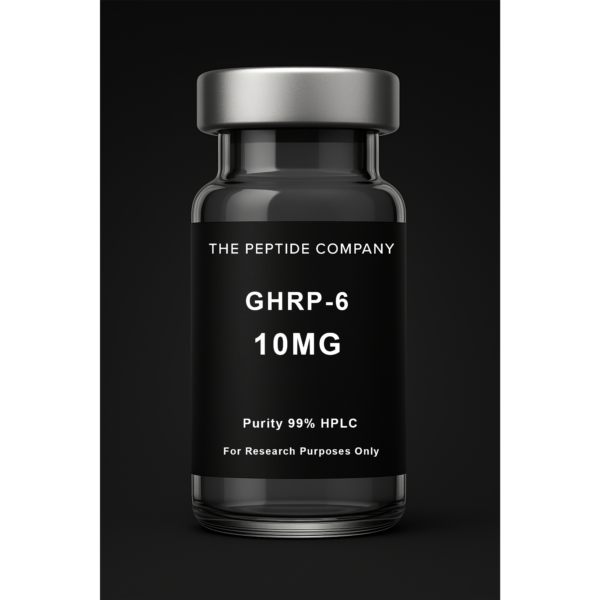
GHRP-6 is a synthetic growth hormone–releasing peptide studied for its interaction with ghrelin receptors and pathways related to growth hormone signaling and metabolic regulation. For research use only.