Abstract & Overview
Decorin is a small leucine-rich proteoglycan (SLRP) naturally present within the extracellular matrix (ECM), where it plays a central role in collagen organization, growth factor regulation, and tissue architecture stability. Unlike short regulatory peptides, Decorin is a structural signaling molecule that interacts directly with transforming growth factor-beta (TGF-β), epidermal growth factor receptor (EGFR), and other key mediators of fibrosis and cellular proliferation. In research contexts, Decorin is studied as a master regulator of extracellular matrix homeostasis and fibrotic signaling pathways.
Extracellular Matrix Biology
The extracellular matrix is a dynamic structural network composed of collagen fibers, proteoglycans, glycoproteins, and signaling molecules. Beyond providing mechanical support, the ECM regulates cell behavior, differentiation, migration, and tissue repair. Dysregulation of ECM turnover contributes to fibrosis, impaired tissue elasticity, and age-associated structural decline. Decorin serves as a key structural and signaling component within this matrix environment.
Molecular Structure and Classification
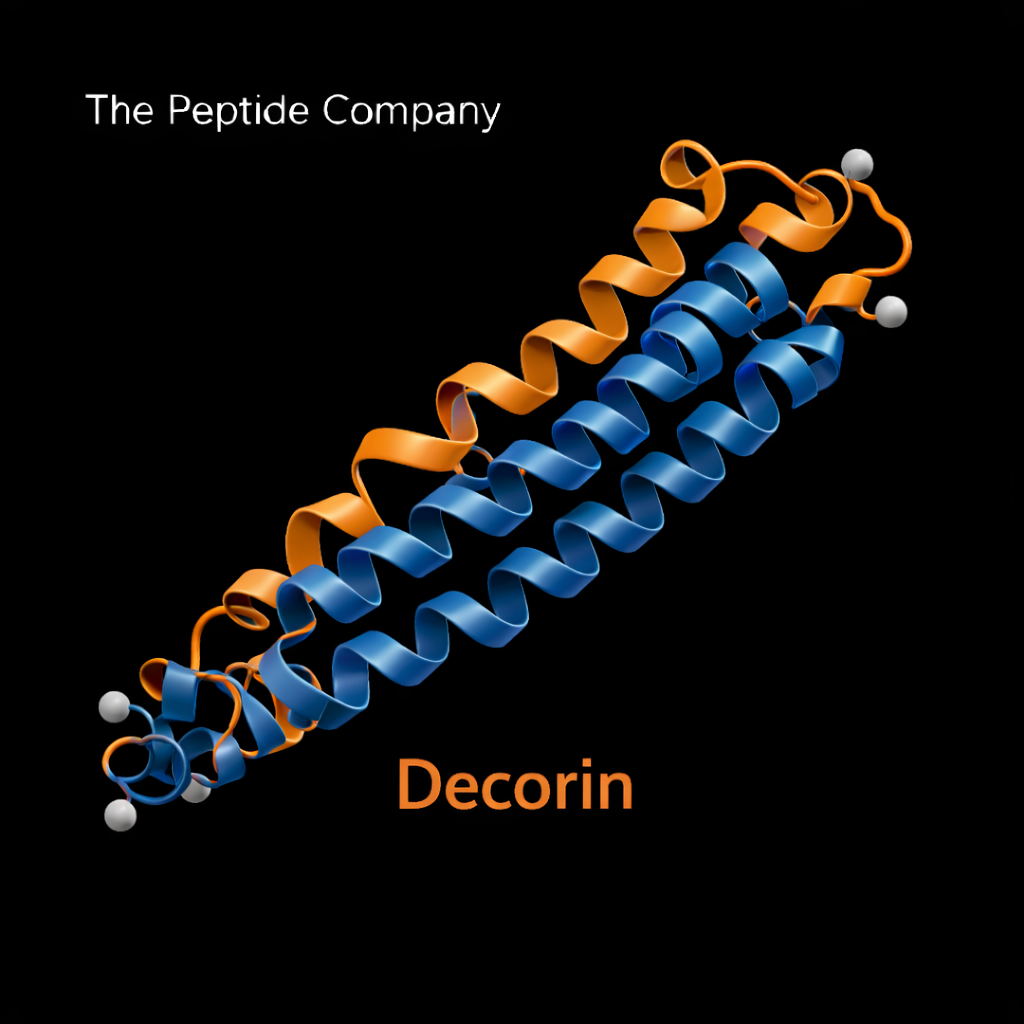
Decorin belongs to the small leucine-rich proteoglycan family and contains a core protein with leucine-rich repeat (LRR) motifs that facilitate protein–protein interactions. It is typically glycosylated with a dermatan sulfate or chondroitin sulfate side chain. This structural configuration enables Decorin to bind collagen fibrils and regulate fibrillogenesis while simultaneously interacting with growth factors embedded within the ECM.
Decorin and TGF-β Regulation
One of Decorin’s most studied functions is its interaction with transforming growth factor-beta (TGF-β), a central mediator of fibrotic signaling. Decorin binds to TGF-β and modulates its bioavailability within the extracellular matrix. By regulating TGF-β activity, Decorin influences downstream signaling pathways involved in collagen deposition, myofibroblast activation, and extracellular matrix remodeling. This interaction positions Decorin as a critical regulator of fibrotic responses in experimental models.
Collagen Organization and Fibrillogenesis
Decorin directly binds to type I collagen fibrils, guiding their diameter, spacing, and structural organization. Proper collagen alignment is essential for tensile strength and tissue integrity. In the absence of adequate Decorin regulation, collagen fibers may become disorganized, contributing to compromised mechanical properties. Through its structural role, Decorin supports balanced connective tissue architecture.
Interaction With Growth Factor Signaling
In addition to TGF-β, Decorin interacts with epidermal growth factor receptor (EGFR), insulin-like growth factor (IGF) pathways, and other signaling molecules embedded in the ECM. These interactions allow Decorin to influence cell proliferation, apoptosis, and differentiation. By modulating receptor activation at the extracellular level, Decorin integrates structural matrix regulation with intracellular signaling cascades.
Fibrosis and Tissue Remodeling Context
Fibrosis is characterized by excessive extracellular matrix deposition and dysregulated collagen synthesis. Experimental studies have demonstrated that altered Decorin expression correlates with changes in fibrotic progression across multiple tissue models. Through its capacity to regulate TGF-β activity and collagen organization, Decorin serves as a key checkpoint within fibrotic signaling networks.
Comparison With Peptide-Based Regulators
Decorin differs fundamentally from short regulatory peptides such as bioregulators or receptor agonists. While peptides typically act through receptor-mediated intracellular signaling, Decorin operates at the extracellular matrix level, influencing growth factor availability and structural protein assembly. This distinction makes Decorin a matrix-level regulator rather than a classical signaling peptide.
Integration With Connective Tissue and Aging Biology
Age-related tissue decline is often associated with extracellular matrix stiffening, collagen crosslinking, and altered growth factor dynamics. Decorin’s regulatory role in collagen organization and growth factor modulation places it at the intersection of fibrosis research and aging biology. Understanding Decorin-mediated matrix signaling contributes to broader insight into tissue resilience and structural homeostasis.
Research Applications and Experimental Models
Decorin is widely studied in models of connective tissue remodeling, fibrosis biology, and growth factor regulation. Experimental systems utilize Decorin to examine ECM–cell communication, TGF-β pathway modulation, and collagen fibril organization. These investigations provide foundational insight into matrix-centered regulatory mechanisms.
Limitations and Ongoing Research Questions
Despite significant progress, questions remain regarding the full scope of Decorin’s receptor interactions, tissue-specific expression patterns, and long-term regulatory effects within complex biological systems. Further research is needed to clarify how Decorin integrates with other extracellular matrix components and systemic signaling pathways.
Summary
Decorin is a small leucine-rich proteoglycan that functions as a master regulator of extracellular matrix architecture and fibrotic signaling. Through modulation of TGF-β activity, collagen fibrillogenesis, and growth factor availability, Decorin integrates structural and signaling roles within connective tissue biology. Its study provides critical insight into fibrosis regulation, tissue remodeling, and extracellular matrix homeostasis.
Educational & Research Disclaimer
This document is provided for educational and scientific research purposes only. No medical, therapeutic, or usage claims are made. Decorin and related compounds are not approved for human use and are intended solely for controlled laboratory and academic investigation.
Decorin is a small leucine-rich proteoglycan (SLRP) found in the extracellular matrix, where it binds collagen fibrils and growth factors. Researchers study Decorin because it regulates collagen architecture, modulates TGF-β signaling, and influences fibrosis, tissue repair, and tumor microenvironments in experimental models.
Decorin can bind directly to TGF-β and related receptors, reducing downstream profibrotic signaling in many in-vitro and in-vivo models. This interaction is used experimentally to explore how altering Decorin levels impacts extracellular matrix deposition, myofibroblast activation, and cytokine profiles in fibrotic disease models.
Decorin binds to type I collagen fibrils and helps control fibril diameter, spacing, and packing. In research systems where Decorin is absent or reduced, collagen fibrils often become irregular and disorganized, which can alter tissue stiffness and mechanical properties. Restoring or overexpressing Decorin is used experimentally to study normalized collagen fibrillogenesis and matrix homeostasis.
In preclinical models of skin, liver, kidney, lung, and cardiac fibrosis, Decorin administration or overexpression has been associated with reduced collagen accumulation, altered TGF-β activity, and changes in inflammatory signaling. These models are used to investigate Decorin as a regulator of fibrotic remodeling and to dissect pathways that may be relevant to scar quality and organ function, strictly within a research context.
Decorin itself is not an approved drug or cosmetic active for treating, curing, or preventing disease. Current work with Decorin is primarily preclinical and mechanistic, using in-vitro systems and animal models. Any material supplied under a research-grade label should be handled only by qualified professionals in controlled laboratory settings and is not for human or veterinary use.
Findings from Decorin research should be viewed as experimental and pathway-focused. They help clarify how extracellular matrix components, TGF-β signaling, and fibrosis interact, but they do not establish clinical safety, efficacy, dosing, or indications. For any health-related decisions, readers should rely on regulatory-approved therapies and medical guidance, not on preclinical Decorin data.
FOXO4-DRI : Targeting Cellular Senescence Through p53–FOXO4 Disruption and Senolytic Research
B7‑33 : Relaxin Pathway Modulation and Fibrosis Regulation in Cellular Signaling Research
Cardiogen: Short Peptide Bioregulator for Cardiac and Myocardial Tissue Research