A New Frontier in Mitochondrial Medicine
Mitochondria regulate cellular energy, stress responses, redox balance, and metabolic flexibility. As these systems decline with age or metabolic stress, mitochondrial dysfunction becomes a driver of fatigue, impaired tissue repair, and systemic metabolic decline.
SS-31, also known as Elamipretide or MTP-131, is a mitochondria-targeted tetrapeptide designed to selectively target the inner mitochondrial membrane and interact with cardiolipin. By stabilizing mitochondrial structure and reducing oxidative stress, SS-31 has become a leading research tool for studying mitochondrial restoration.
What Is SS-31?
SS-31 is a synthetic mitochondria-targeted tetrapeptide with the sequence D-Arg-Dmt-Lys-Phe-NH₂.
It can:
• Cross mitochondrial membranes
• Concentrate at the inner mitochondrial membrane
• Bind electrostatically to cardiolipin
• Support mitochondrial architecture and ATP production
Unlike general antioxidants, SS-31 modulates ROS production at the source while preserving physiological signaling.
Mechanism of Action
1. Cardiolipin Stabilization
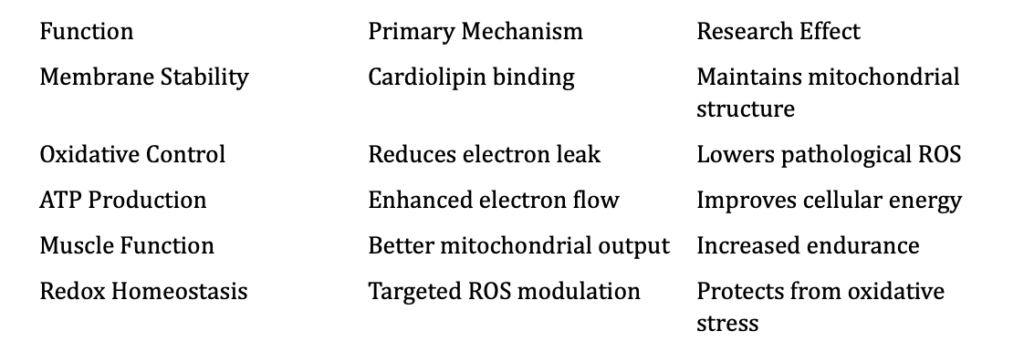
SS-31 binds directly to cardiolipin, helping maintain membrane curvature, respiratory chain structure, and ATP synthesis efficiency.
2. Reduced ROS Production
By stabilizing membrane architecture, SS-31 reduces “electron leak” that generates excess ROS. This improves redox balance while maintaining physiological signaling.
3. Enhanced ATP Generation
With more efficient electron flow, SS-31 supports improved mitochondrial energy output and muscular performance.
4. Protection Against Mitochondrial Stress
SS-31 has been evaluated in models of ischemia-reperfusion injury, age-related decline, metabolic syndrome, and mitochondrial diseases.
Research Highlights
1. Muscle Function and Fatigue
Improves skeletal muscle endurance, mitochondrial respiration, and ATP turnover.
2. Cardiac Performance
Supports healthier mitochondrial morphology, reduces oxidative stress, and improves cardiac output in research settings.
3. Age-Related Mitochondrial Decline
Reverses cardiolipin oxidation, restores respiratory chain stability, and enhances endurance in aging models.
4. Mitochondrial Disorders
Improves mitochondrial structure and oxygen utilization in studies of mitochondrial pathology.
Cellular Pathways Overview
Synergistic Combinations (Research Context)
• MOTS-c — enhances mitochondrial signaling and AMPK activation
• 5-Amino-1MQ — improves NAD⁺ availability and metabolic pathways
• NAD⁺ precursors — support sirtuin activity and mitochondrial energy
• Glutathione — reinforces redox balance during mitochondrial output
Research Use and Safety
SS-31 has undergone extensive preclinical and early clinical evaluation.
Key points:
• Generally well-tolerated in research environments
• Effects are most pronounced under mitochondrial stress
• Not approved for clinical or consumer use
All descriptions refer strictly to laboratory and research-only contexts.
Summary
SS-31 represents a shift in mitochondrial science toward targeted membrane stabilization. By binding cardiolipin, reducing electron leak, and supporting ATP generation, SS-31 restores a fundamental layer of cellular energy production.
Its effects on muscle function, cardiac resilience, and age-related mitochondrial decline position SS-31 as a central molecule in metabolic and longevity research.
References (Selection)
1. Birk AV, et al. J Am Soc Nephrol. (2013).
2. Szeto HH. Pharmacology & Therapeutics. (2014).
3. Zhao K, et al. J Biol Chem. (2004).
4. Kloner RA, et al. Circulation. (2015).
5. Dai DF, et al. Aging Cell. (2017).
Educational & Research Disclaimer
This content is for educational and research purposes only. No medical advice or product claims are implied. Compounds discussed are not approved for human or clinical use and are intended for in-vitro laboratory research only.
———————–
SS-31 is a mitochondria-targeted tetrapeptide studied for promoting mitochondrial protection, stabilizing cardiolipin, and supporting cellular energy output in preclinical models.
Research shows SS-31 localizes to the inner mitochondrial membrane, where it binds cardiolipin and may help reduce oxidative stress and improve electron transport efficiency.
No. SS-31 from The Peptide Company is intended strictly for laboratory and in-vitro research use and is not approved for human, medical, or clinical use.
SS-31 is explored in cell and animal models examining mitochondrial dysfunction, bioenergetics, oxidative stress, membrane stability, and aging-related metabolic decline.
Some preclinical work suggests SS-31 may improve mitochondrial coupling efficiency and ATP output, though these findings remain research-only and non-medical.
Researchers store SS-31 lyophilized in cool, light-protected conditions and reconstitute it following standard laboratory procedures and institutional guidelines.
No. SS-31 is not for human use, self-administration, or consumption of any kind. It is for controlled research environments only.
MOTS-c: The Mitochondrial-Encoded Peptide for Metabolic Regulation and Cellular Resilience
NMN: NAD⁺ Precursor Biology, Cellular Metabolism, and Mitochondrial Research
SS-31 10mg is a research compound studied for mitochondrial targeting, bioenergetic efficiency, and cardiolipin stabilization pathway mechanisms. For research use only.