A New Direction in Cellular Energy Control
Cellular metabolism is shaped by a network of nutrient-sensing pathways that regulate energy production, fat storage, and mitochondrial efficiency. While much attention has focused on AMPK activation, NAD⁺ metabolism, and mitochondrial peptides, another key regulatory node is emerging: nicotinamide N-methyltransferase (NNMT).
NNMT is an enzyme involved in methylation balance and NAD⁺ availability. When NNMT becomes overactive, it disrupts metabolic flexibility and contributes to weight gain, insulin resistance, and reduced cellular energy.
5-Amino-1MQ is a small-molecule research compound studied for its ability to inhibit NNMT, rebalance metabolic signaling, and support healthier NAD⁺ dynamics. As part of the “Mitochondrial & Metabolic Optimization” series, it follows naturally after MOTS-c by highlighting how metabolism can be regulated through intracellular enzymatic control.
What Is 5-Amino-1MQ?
5-Amino-1MQ (5-amino-1-methylquinolinium) is a potent NNMT inhibitor evaluated in metabolic, obesity, and cellular energy research. Unlike peptide-based molecules, 1MQ is a small organic compound with high cellular penetration.
NNMT plays a role in:
• methylation balance
• NAD⁺ recycling
• lipid storage
• metabolic rate
• insulin sensitivity
When NNMT is elevated, it diverts methyl groups, alters nicotinamide availability, and disrupts metabolic processes. 1MQ’s purpose in research is to rebalance this pathway.
Mechanism of Action
1. NNMT Inhibition
NNMT converts nicotinamide into 1-methylnicotinamide (MNA), which cannot be recycled into NAD⁺. When NNMT is active:
• NAD⁺ levels fall
• Lipid accumulation increases
• Methylation imbalance occurs
5-Amino-1MQ blocks this process, resulting in:
• Increased nicotinamide
• Greater NAD⁺ synthesis potential
• Improved oxidative metabolism
2. NAD⁺ Regulation
By preventing NAD⁺ depletion, 1MQ supports:
• sirtuin activity
• mitochondrial function
• DNA repair signaling
• redox balance
3. Enhanced Metabolic Efficiency
Observed effects include:
• reduced adipocyte size
• decreased lipid storage
• improved glucose tolerance
4. Methylation Balance
NNMT consumes methyl donors. Inhibiting NNMT improves SAM availability and stabilizes gene expression patterns involved in metabolism.
Research Highlights
1. Fat Mass Reduction
5-Amino-1MQ reduces adipocyte size and systemic fat accumulation in research models.
2. Improved Glucose Handling
Demonstrates enhanced insulin sensitivity and glucose uptake.
3. Increased NAD⁺ Availability
Supports metabolic efficiency, mitochondrial function, and redox balance.
4. Anti-Obesity Effects
Helps regulate lipid storage and increases energy expenditure.
Synergistic Combinations (Research Context)
• MOTS-c — complements AMPK activation and metabolic adaptation
• SS-31 — supports mitochondrial membrane health
• NAD⁺ precursors — synergize with 1MQ’s nicotinamide preservation
• Glutathione — supports redox balance under increased metabolic output
Research Use and Safety
5-Amino-1MQ has been evaluated in metabolic and cellular research models.
Key points:
• No significant toxicity reported at research levels
• Metabolic benefits are dose-dependent
• Human studies remain limited
• Not approved for medical or consumer use
All mentions refer strictly to research-only contexts.
Summary
5-Amino-1MQ represents a promising direction in metabolic regulation by targeting NNMT, a key enzyme that influences NAD⁺ availability, methylation balance, and lipid metabolism.
Through NNMT inhibition and NAD⁺ preservation, 1MQ supports improved metabolic efficiency, reduced fat accumulation, and enhanced cellular energy expenditure.
References (Selection)
1. Kraus D, et al. Nature Medicine. (2014).
2. Ulanovskaya OA, et al. Nature Chemical Biology. (2013).
3. Stromsdorfer KL, et al. J Biol Chem. (2016).
4. Kannt A, et al. Drug Discovery Today. (2021).
Educational & Research Disclaimer
This content is for educational and research purposes only. No medical advice or product claims are implied. Compounds discussed are not approved for human or clinical use and are intended for in-vitro laboratory research only.
———————-
5-Amino-1MQ is a small-molecule NNMT inhibitor studied for its effects on cellular metabolism, NAD+ regulation, and energy efficiency in preclinical models.
Research indicates that 5-Amino-1MQ inhibits nicotinamide N-methyltransferase (NNMT), a metabolic enzyme that influences NAD+ turnover, energy expenditure, and methylation balance in cells.
No. 5-Amino-1MQ from The Peptide Company is intended exclusively for laboratory and in-vitro research. It is notapproved for human consumption, supplementation, or therapeutic use.
5-Amino-1MQ is studied in metabolic models to explore weight regulation, adipocyte energy mobilization, and NAD+-dependent cellular pathways. All investigations remain preclinical.
Many studies examine how NNMT inhibition may modulate intracellular NAD+ availability and downstream signaling, but these findings are experimental and not connected to medical claims.
Researchers typically store and handle the compound under standard small-molecule laboratory protocols, including dry, cool conditions and protection from light.
No. Research compounds on this site are not intended for any form of self-administration. All work must be conducted by qualified personnel in controlled research settings.
Related Research Compounds:
GLP-1 Pathway Peptides: Comparative Research on Semaglutide, Tirzepatide & Retatrutide
Frag 176–191: Growth Hormone–Derived Fragment and Lipolytic Research Mechanisms
NMN: NAD⁺ Precursor Biology, Cellular Metabolism, and Mitochondrial Research
PMID: 25555209 — NNMT regulation and metabolic energy balance
PMID: 29284151 — NNMT inhibition and adipocyte metabolism
PMID: 28087616 — NAD+ turnover and cellular signaling
PMID: 31727847 — Enzyme pathways involved in NAD+-dependent regulation
PMID: 33785733 — Small-molecule modulation of metabolic efficiency
Frontiers in Pharmacology — NNMT inhibitors and metabolic research
Journal of Biological Chemistry — NAD+ biosynthesis and enzymatic regulation
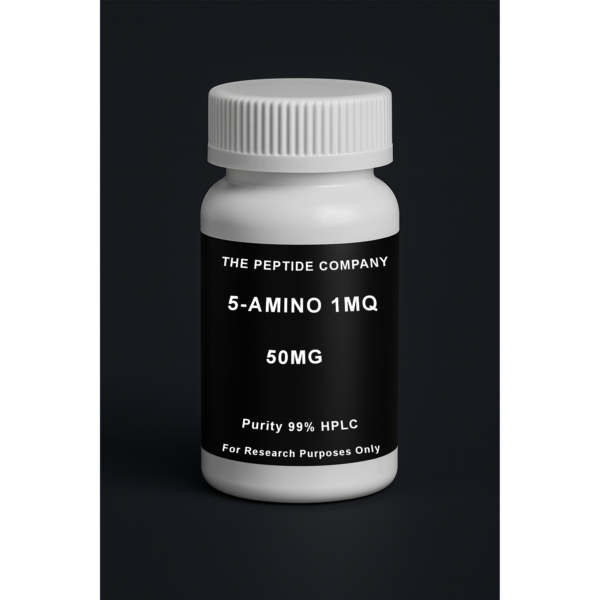
5-Amino-1MQ 50mg capsules are a research compound studied for NNMT pathway modulation, metabolic efficiency signaling, and energy balance regulation. For research use only.