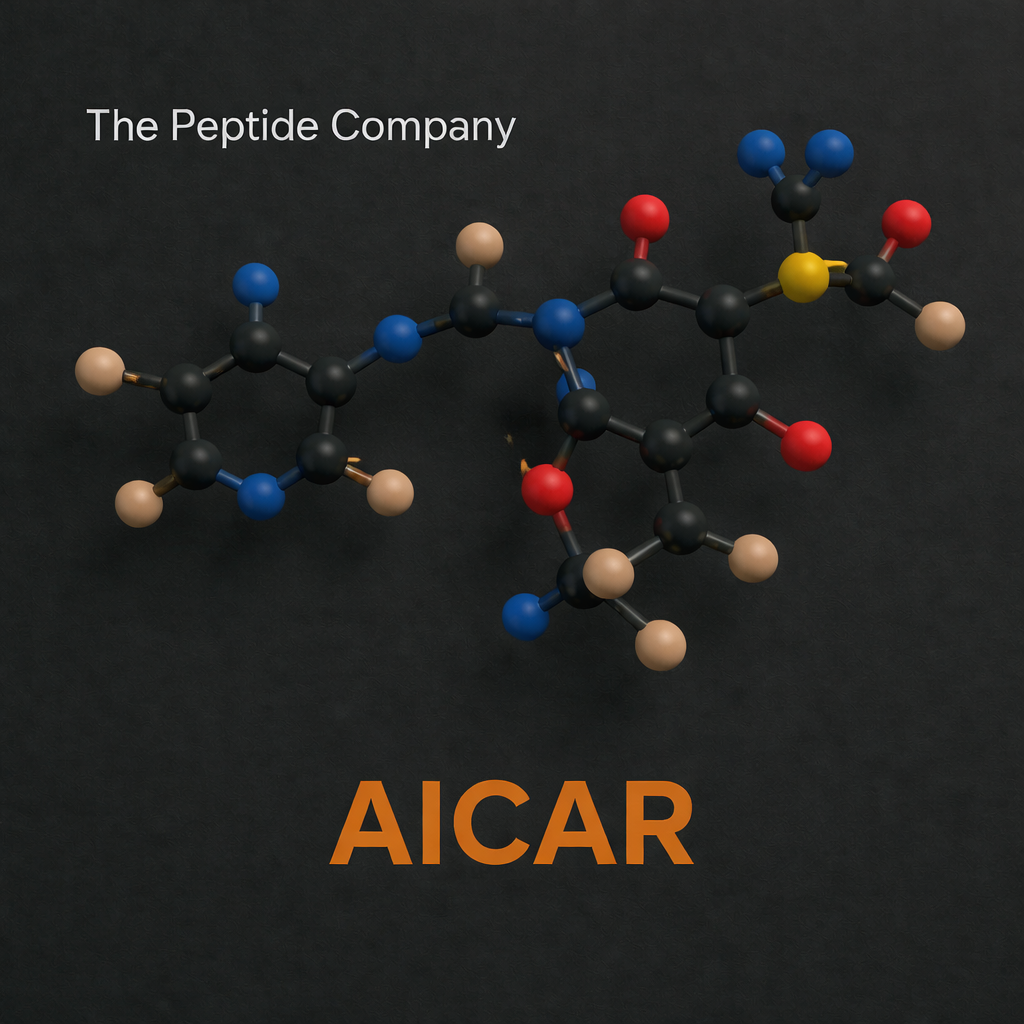
Introduction
5‑Aminoimidazole‑4‑carboxamide ribonucleotide (AICAR) is a cell‑permeable adenosine analog widely used in research to study cellular energy sensing and metabolic regulation. Once inside cells, AICAR is phosphorylated to ZMP, an AMP mimetic that activates AMP‑activated protein kinase (AMPK). Through this mechanism, AICAR serves as a foundational tool for investigating energy stress responses, mitochondrial biogenesis, and exercise‑mimetic signaling pathways.
Chemical Properties and Intracellular Conversion
AICAR enters cells via nucleoside transporters and is rapidly converted to ZMP by adenosine kinase. ZMP structurally and functionally resembles AMP, allowing it to interact with AMPK regulatory subunits. This conversion bypasses upstream energetic stress, enabling controlled activation of energy‑sensing pathways in experimental models.
AMPK Structure and Activation Mechanism
AMPK is a heterotrimeric kinase composed of catalytic α and regulatory β and γ subunits. ZMP binding to the γ subunit promotes AMPK activation by enhancing phosphorylation of the α subunit at Thr172 and protecting it from dephosphorylation. Research examines how AICAR‑induced AMPK activation differs from physiological activation driven by ATP depletion.
Metabolic Reprogramming and Substrate Utilization
Activation of AMPK by AICAR shifts cellular metabolism toward catabolic processes that generate ATP. Research models demonstrate increased fatty acid oxidation through inhibition of acetyl‑CoA carboxylase (ACC), enhanced glucose uptake via GLUT4 translocation, and suppression of anabolic pathways such as lipid and protein synthesis.
Mitochondrial Biogenesis and Oxidative Capacity
AICAR‑mediated AMPK activation influences mitochondrial biogenesis through regulation of PGC‑1α and related transcriptional networks. Studies examine changes in mitochondrial DNA content, respiratory enzyme expression, and oxidative phosphorylation capacity following AMPK activation in skeletal muscle and other tissues.
Exercise‑Mimetic Signaling Research
AICAR is frequently described in research as an exercise mimetic due to its ability to activate AMPK‑dependent pathways associated with endurance adaptation. Experimental models explore overlaps and distinctions between AICAR‑induced signaling and mechanical exercise, including effects on muscle fiber composition and metabolic efficiency.
Cardiac and Skeletal Muscle Research
In muscle research, AICAR is used to study energy stress responses, contractile efficiency, and metabolic flexibility. Cardiac models investigate its influence on substrate utilization, ischemic tolerance, and mitochondrial resilience under energetic challenge.
Signal Specificity and Research Limitations
While AICAR is a powerful research tool, ZMP can interact with AMP‑sensitive enzymes beyond AMPK. Studies emphasize the importance of distinguishing AMPK‑dependent and AMPK‑independent effects when interpreting results. Dose, exposure time, and tissue context significantly influence signaling outcomes in experimental systems.
Summary
AICAR is a widely used experimental compound for probing AMPK activation, energy‑sensing mechanisms, mitochondrial adaptation, and exercise‑related metabolic signaling. Its ability to selectively engage cellular energy pathways makes it a central molecule in metabolic and mitochondrial research.
Educational & Research Disclaimer
This article is for educational and scientific research purposes only. No therapeutic claims or usage recommendations are provided. Compounds referenced are not approved for human use and are intended solely for controlled laboratory experimentation.
AICAR (5-Aminoimidazole-4-carboxamide ribonucleotide) is a synthetic adenosine analog commonly used in research to study cellular energy sensing and AMP-activated protein kinase (AMPK) signaling pathways.
Inside cells, AICAR is converted to ZMP, an AMP mimetic that binds to AMPK and promotes its activation, allowing researchers to study downstream effects of energy stress signaling without altering ATP directly.
AICAR activates many of the same intracellular pathways stimulated by endurance exercise—particularly AMPK-dependent pathways involved in mitochondrial biogenesis and substrate utilization—making it useful in exercise physiology models.
AICAR is frequently used to investigate AMPK-related pathways such as mitochondrial biogenesis (PGC-1α), glucose uptake, fatty-acid oxidation, and metabolic adaptation under energetic stress.
No. AICAR is not a peptide. It is a small-molecule nucleoside analog, though it is often discussed alongside peptides due to its use in metabolic and signaling research.
AICAR has been studied in cell culture, animal models, and controlled laboratory settings to explore metabolic regulation, mitochondrial function, and energy-sensing mechanisms.
AICAR is primarily a research compound and is not approved for general clinical use. Its role is largely limited to experimental and mechanistic studies.
Apelin : APJ Receptor Signaling, Cardiovascular Regulation, and Metabolic Research Pathways
Cardiogen: Short Peptide Bioregulator for Cardiac and Myocardial Tissue Research