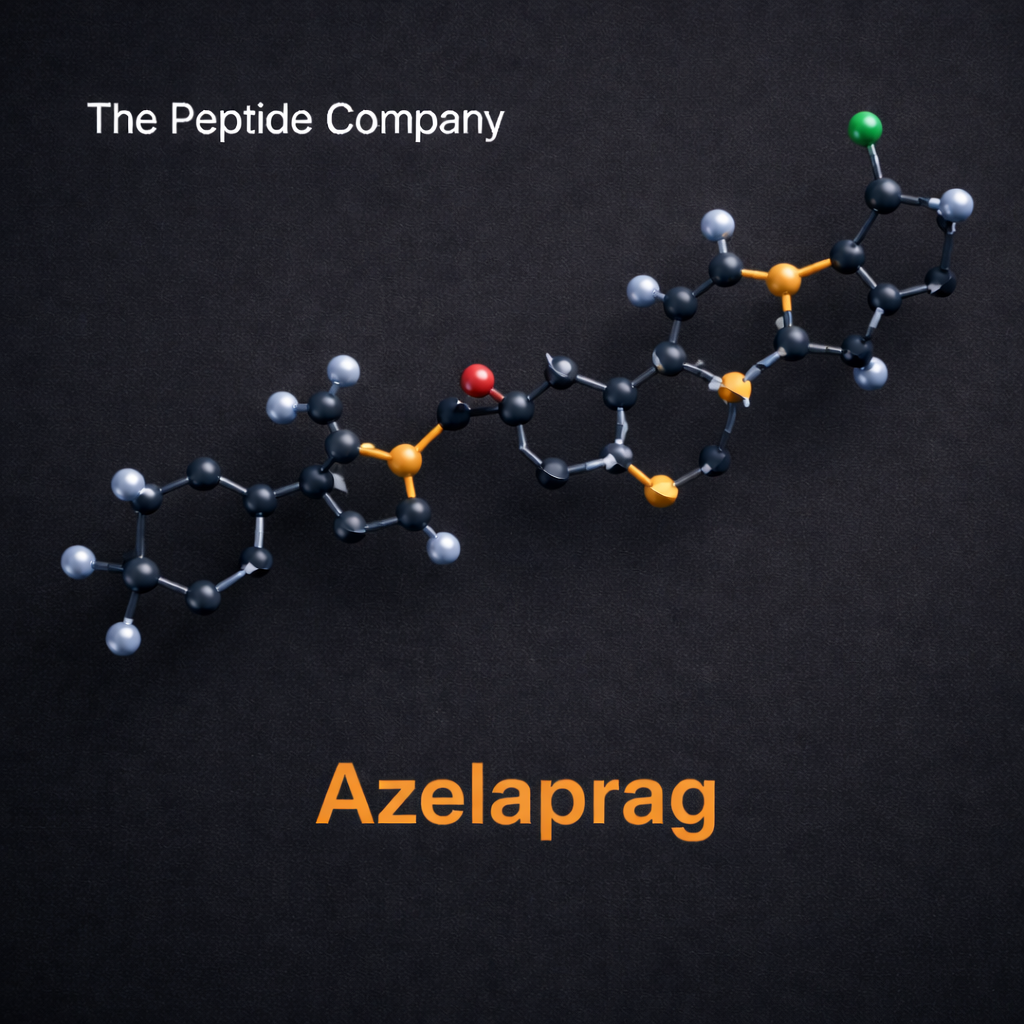
Abstract & Overview
Azelaprag is a small‑molecule agonist of the growth hormone secretagogue receptor type 1a (GHS‑R1a), a G‑protein–coupled receptor primarily involved in the regulation of growth hormone (GH) secretion, appetite control, and energy balance. It functions as a non‑peptide mimic of endogenous ghrelin and peptide secretagogues such as GHRP‑2, Hexarelin, and MK‑677, while demonstrating oral bioavailability and receptor selectivity in experimental models. Azelaprag’s mechanistic framework provides researchers with a tool to investigate the interplay between ghrelin signaling, neuroendocrine feedback, and metabolic homeostasis.
Molecular Classification and Pharmacology
Azelaprag belongs to the class of non‑peptide GHS‑R1a agonists designed to reproduce the physiological activity of ghrelin. Unlike native ghrelin, which requires post‑translational acylation for receptor activation, Azelaprag interacts directly with the receptor’s orthosteric site, inducing conformational shifts that engage Gq/11‑coupled intracellular cascades. Its structure facilitates enhanced stability, receptor selectivity, and blood–brain barrier permeability—properties that make it particularly useful for studying central and peripheral aspects of the ghrelin axis.
Receptor Biology: GHS‑R1a Signaling Network
The GHS‑R1a receptor is expressed in the hypothalamus, pituitary, hippocampus, pancreas, and gastrointestinal tract. Upon agonist binding, it activates Gq/11‑dependent pathways, resulting in phospholipase C (PLC) stimulation and subsequent production of inositol triphosphate (IP3) and diacylglycerol (DAG). This cascade elevates intracellular Ca²⁺ concentrations and protein kinase C (PKC) activation, which in turn stimulates growth hormone release and modulates neuronal excitability. Downstream signaling involves MAPK/ERK, PI3K/Akt, and AMPK pathways, linking receptor activity to both anabolic and metabolic responses.
Endocrine and Metabolic Research Findings
Research with Azelaprag and related agonists demonstrates increased pulsatile GH secretion through pituitary activation and enhanced GH‑releasing hormone (GHRH) responsiveness. This cascade influences systemic insulin‑like growth factor‑1 (IGF‑1) levels, tissue anabolism, and cellular repair signaling. Additionally, GHS‑R1a activation modulates glucose and lipid metabolism by altering AMPK activity and promoting substrate mobilization during energy deficit states. These findings have positioned Azelaprag as a valuable agent in experimental models exploring the intersection between endocrine function and metabolic regulation.
Central Nervous System and Cognitive Pathways
Beyond its endocrine role, GHS‑R1a signaling is studied for its effects on neurogenesis, synaptic plasticity, and cognitive function. The receptor’s expression in the hippocampus and ventral tegmental area (VTA) suggests involvement in learning, motivation, and reward processing. Research models show that ghrelin receptor activation can enhance memory retention, increase dendritic spine density, and mitigate oxidative stress in neuronal tissues. Azelaprag’s ability to penetrate the blood–brain barrier allows for examination of these central effects without requiring peptide transport mechanisms.
Comparative Analysis: Azelaprag vs. Peptide Secretagogues
Azelaprag shares functional similarities with peptide‑based secretagogues such as GHRP‑2, GHRP‑6, Hexarelin, and MK‑677, but differs in receptor kinetics and pharmacokinetics. Whereas peptide agonists rely on extracellular binding pockets with variable half‑lives, Azelaprag’s small‑molecule framework affords improved oral bioavailability, metabolic stability, and duration of receptor occupancy. Comparative studies indicate that Azelaprag produces sustained GHS‑R1a activation with reduced desensitization, allowing for long‑term signaling observation without peptide degradation artifacts.
Energy Balance and Appetite Research
Activation of GHS‑R1a is closely tied to appetite regulation and energy expenditure. Azelaprag is used in research models to investigate orexigenic signaling through hypothalamic neuropeptide Y (NPY) and agouti‑related peptide (AgRP) neurons, which integrate peripheral metabolic cues with central hunger responses. Concurrent modulation of dopaminergic reward pathways highlights the receptor’s dual role in metabolic drive and motivational behavior.
Mitochondrial and Metabolic Integration
Emerging studies link ghrelin receptor activation to mitochondrial dynamics, including biogenesis, uncoupling, and reactive oxygen species (ROS) regulation. Through AMPK and SIRT1 interaction, GHS‑R1a signaling influences cellular energy efficiency and metabolic resilience under stress conditions. Azelaprag’s stable receptor engagement provides a platform to examine how chronic GHS‑R1a activation affects mitochondrial quality control, autophagy, and oxidative metabolism.
Summary
Azelaprag serves as a non‑peptide model compound for exploring GHS‑R1a‑mediated signaling in both central and peripheral tissues. Its receptor selectivity, oral bioavailability, and sustained activation kinetics distinguish it from earlier peptide secretagogues, enabling in‑depth research into growth hormone dynamics, metabolic integration, and neuroendocrine regulation. By bridging endocrine and metabolic mechanisms, Azelaprag contributes to the expanding field of ghrelin receptor research and energy homeostasis modeling.
Educational & Research Disclaimer
This article is for educational and scientific research purposes only. No therapeutic claims or usage recommendations are provided. Compounds referenced are not approved for human use and are intended solely for controlled laboratory experimentation.
Azelaprag is investigated as a small-molecule agonist of the ghrelin receptor (GHS-R1a). Research models use it to study growth hormone secretagogue signaling, appetite regulation, neuroendocrine feedback, and energy balance without relying on peptide-based ligands.
Unlike peptide secretagogues (e.g., GHRP-2, GHRP-6, hexarelin), Azelaprag is non-peptide, allowing researchers to examine ghrelin receptor activation with improved molecular stability, consistent receptor engagement, and reduced peptide degradation artifacts in experimental systems.
Studies focus on GHS-R1a–mediated signaling, including downstream effects on growth hormone release, hypothalamic appetite circuits, neuroendocrine modulation, and interactions with metabolic regulators such as AMPK and dopaminergic pathways.
No. Azelaprag is referenced in preclinical and controlled research contexts only. It is not approved for human or veterinary use and is utilized strictly for laboratory investigation of ghrelin receptor biology.
Ghrelin receptor agonists provide a controlled way to study energy homeostasis, appetite signaling, hormonal feedback loops, and mitochondrial–metabolic integration, helping researchers understand how central and peripheral systems coordinate metabolic responses.
These references support ghrelin receptor (GHS-R1a) signaling, growth hormone secretagogues, and metabolic pathway research relevant to Azelaprag’s mechanism:
Follistatin: Myostatin-Regulated Pathways and Advanced Muscle Research