Abstract & Overview
Delta Sleep-Inducing Peptide (DSIP) is an endogenous nonapeptide originally isolated in 1974 from the cerebral venous blood of rabbits during an induced state of sleep. Despite its name, decades of subsequent research have revealed that DSIP is far more than a simple somnogenic agent. It acts as a profound, multifaceted neuroendocrine modulator capable of regulating the hypothalamic-pituitary-adrenal (HPA) axis, altering neurotransmitter dynamics, and exerting significant stress-limiting and neuroprotective effects [1] [2].
While its precise genetic precursor and definitive receptor remain elusive, DSIP’s broad distribution across the hypothalamus, limbic system, and pituitary gland points to its fundamental role in maintaining physiological homeostasis. In experimental models, DSIP has demonstrated remarkable efficacy in promoting slow-wave sleep (SWS), attenuating stress-induced cortisol release, modulating the release of luteinizing hormone (LH) and growth hormone (GH), and even providing anticonvulsant and analgesic properties [3] [4].
“DSIP is an amphiphilic peptide that co-localizes with many peptide and non-peptide mediators in the pituitary and gut. Its ability to interact with the MAPK cascade and its homology to glucocorticoid-induced leucine zipper (GILZ) suggest it serves as a critical link between circadian mechanisms, stress adaptation, and neuroendocrine regulation.” — Gimble et al., Obesity Reviews [5].
Molecular Identity and Structural Architecture
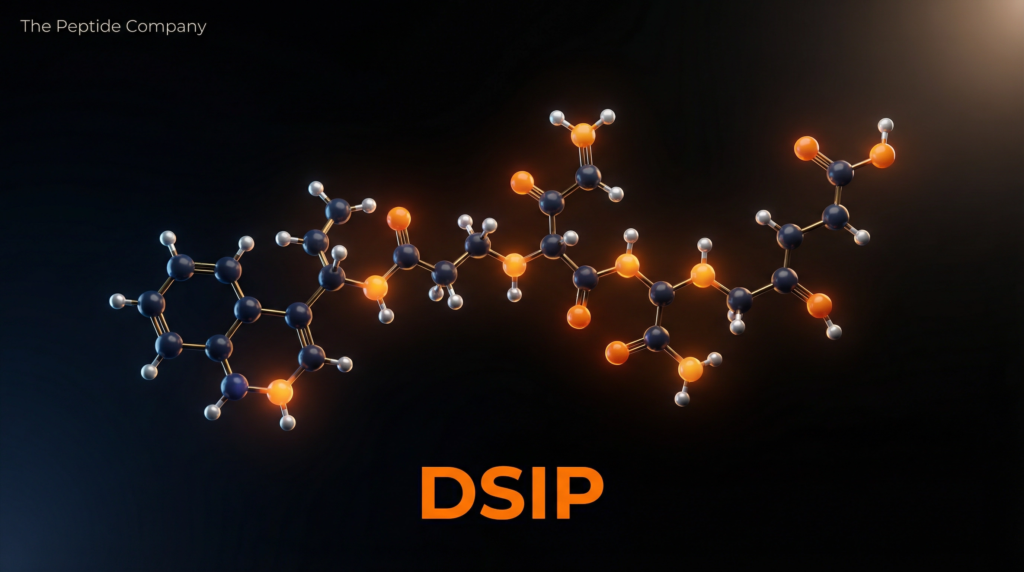
DSIP is a highly conserved, amphiphilic nonapeptide with a molecular weight of 850 Daltons. Its specific amino acid sequence is Trp-Ala-Gly-Gly-Asp-Ala-Ser-Gly-Glu (WAGGDASGE). The structure is unique in that it lacks a defined genetic origin in mammalian models; however, BLAST alignments suggest homology with certain bacterial proteins, hinting at a highly conserved evolutionary lineage [6].
In vivo, native DSIP has a relatively short half-life of approximately 15 minutes due to rapid degradation by aminopeptidase-like enzymes [7]. To counteract this, endogenous DSIP is believed to complex with specific carrier proteins. In clinical and research settings, synthetic analogues and specialized preparations (such as Deltaran) are often utilized to enhance molecular stability and prolong bioactivity [8].
Mechanistic Rationale: CNS and Endocrine Signaling
The pharmacological utility of DSIP lies in its broad, systemic modulatory capacity. Rather than acting as a direct agonist for a single receptor, DSIP functions as a regulatory peptide that restores homeostasis across multiple neural and endocrine networks.
Neurotransmitter Modulation and Sleep Architecture
The primary action of DSIP in the central nervous system involves the induction of spindle and delta EEG activity, the hallmark of deep, restorative slow-wave sleep (SWS) [1]. Recent studies utilizing DSIP fusion peptides (such as DSIP-CBBBP) in PCPA-induced insomnia models have demonstrated its ability to significantly modulate and restore neurotransmitter balance. DSIP administration regulates levels of serotonin (5-HT), dopamine (DA), glutamate, and melatonin, effectively reversing neurotransmitter dysregulation associated with severe sleep deprivation [9].
HPA Axis Regulation and Stress Limitation
DSIP exerts a powerful inhibitory effect on the stress response. Research indicates that DSIP significantly reduces corticotropin-releasing factor (CRF)-induced corticosterone release at the level of the pituitary gland [10]. By decreasing basal corticotropin (ACTH) levels and blocking its stress-induced release, DSIP acts as a potent stress-limiting factor. Furthermore, its homology to GILZ (glucocorticoid-induced leucine zipper) allows it to interact with the MAPK cascade, preventing Raf-1 activation and inhibiting ERK phosphorylation—a crucial pathway in cellular stress signaling [5].
Pituitary Hormone Release: LH and GH
Beyond the HPA axis, DSIP modulates the hypothalamic-pituitary-gonadal (HPG) and somatotropic axes. In rat models, microinjections of DSIP have been shown to stimulate the release of luteinizing hormone (LH) [11]. Additionally, DSIP is a physiological stimulus for sleep-related growth hormone (GH) release. Sleep deprivation naturally increases endogenous DSIP, which in turn drives the secretion of somatoliberin (GHRH) and GH while inhibiting somatostatin [3].
Research Applications and Experimental Evidence
Substance Withdrawal and Addiction Recovery
One of the most compelling clinical applications of DSIP involves the treatment of opioid and alcohol withdrawal syndromes. DSIP has been shown to act antagonistically on opiate receptors, significantly inhibiting the development of dependence. In landmark clinical trials, administration of DSIP produced a beneficial, immediate-onset alleviation of withdrawal symptoms in 97% of opiate-dependent and 87% of alcohol-dependent patients, drastically reducing anxiety and sleep disturbances during detoxification [12] [13].
Mitochondrial Protection and Antioxidant Effects
In vitro studies on rat brain mitochondria have revealed that DSIP enhances the efficiency of oxidative phosphorylation. Under conditions of experimental hypoxia, DSIP demonstrated pronounced stress-protective and antioxidant properties, preserving mitochondrial respiratory chain function and mitigating cellular damage [14].
Narcolepsy and Sleep Disorders
While initially studied for insomnia, DSIP has shown paradoxical benefits in narcolepsy. In clinical case studies, DSIP administration reduced the frequency of daytime sleep attacks while simultaneously increasing daytime activity, alertness, and performance. The nocturnal sleep period was compressed with fewer interruptions, suggesting that DSIP normalizes the overall circadian rhythm rather than simply acting as a sedative [15].
Systemic Effects of DSIP Administration
| Physiological System | Observed Effects in Research Models |
| Central Nervous System | Induces delta EEG activity (SWS); restores 5-HT, DA, and glutamate balance; provides anticonvulsant and analgesic effects. |
| HPA Axis (Stress) | Reduces CRF-induced corticosterone release; lowers basal ACTH; modulates MAPK/ERK cellular stress signaling. |
| Endocrine System | Stimulates LH release; promotes sleep-related GH secretion; inhibits somatostatin. |
| Mitochondrial Function | Enhances oxidative phosphorylation efficiency; provides antioxidant protection during hypoxia. |
| Receptor Interaction | Modulates NMDA receptors; acts antagonistically on opiate receptors to alleviate withdrawal symptoms. |
Conclusion
Delta Sleep-Inducing Peptide represents a highly versatile and potent endogenous regulatory compound. Far surpassing its initial designation as a sleep-promoting agent, DSIP serves as a crucial neuroendocrine modulator that bridges the gap between circadian regulation, stress adaptation, and hormonal balance. Its proven efficacy in restoring slow-wave sleep, blunting cortisol responses, protecting mitochondrial function, and alleviating severe withdrawal syndromes underscores its immense value in both neurological and endocrine research. As investigations into stable synthetic analogues continue, DSIP remains one of the most promising peptides for comprehensive CNS and metabolic restoration.
References
[1] Schoenenberger GA, et al. A naturally occurring delta-EEG enhancing nonapeptide in rabbits. European Journal of Physiology. 1977;369(2):99-109.
[2] Kovalzon VM, Strekalova TV. Delta sleep-inducing peptide (DSIP): a still unresolved riddle. Journal of Neurochemistry. 2006;97(2):303-309.
[3] Iyer KS, Marks GA, Kastin AJ, McCann SM. Evidence for a role of delta sleep-inducing peptide in slow-wave sleep and sleep-related growth hormone release in the rat. PNAS. 1988;85(10):3653-3656.
[4] Schoenenberger GA. Characterization, properties and multivariate functions of Delta-Sleep Inducing Peptide (DSIP). European Neurology. 1984;23(5):321-345.
[5] Gimble JM, et al. Delta sleep-inducing peptide and glucocorticoid-induced leucine zipper: potential links between circadian mechanisms and obesity? Obesity Reviews. 2009;10:46-51.
[6] Delta-sleep-inducing peptide. Wikipedia. https://en.wikipedia.org/wiki/Delta-sleep-inducing_peptide
[7] Pollard BJ, Pomfrett CJ. Delta sleep-inducing peptide. European Journal of Anaesthesiology. 2001;18(7):419-422.
[8] Khvatova EM, et al. Delta sleep inducing peptide (DSIP): effect on respiration activity in rat brain mitochondria and stress protective potency under experimental hypoxia. Peptides. 2003;24(2):307-311.
[9] Mu X, et al. Pichia pastoris secreted peptides crossing the blood-brain barrier and DSIP fusion peptide efficacy in PCPA-induced insomnia mouse models. Frontiers in Pharmacology. 2024;15:1439536.
[10] Graf MV, Kastin AJ, Coy DH, Fischman AJ. Delta-Sleep-Inducing Peptide Reduces CRF-Induced Corticosterone Release. Neuroendocrinology. 1985;41(4):353-356.
[11] Iyer KS, McCann SM. Delta sleep inducing peptide (DSIP) stimulates the release of LH but not FSH via a hypothalamic site of action in the rat. Brain Research Bulletin. 1987;19(5):535-538.
[12] Dick P, Costa C. DSIP in the treatment of withdrawal syndromes from alcohol and opiates. European Neurology. 1984;23(5):364-371.
[13] Kastin AJ, et al. Opioid detoxification with delta sleep-inducing peptide: results of an open clinical trial. Journal of Clinical Psychopharmacology. 1998.
[14] Bobyntsev II, et al. Influence of delta-sleep peptide on the enzymatic activity of the mitochondrial electron transport chain in various rat tissues with aging of the organism. Advances in Gerontology. 2015.
[15] Schneider-Helmert D. Effects of DSIP on narcolepsy. European Neurology. 1984;23(5):353-364.
Disclaimer: This article is intended strictly for research and educational review purposes. The compounds discussed (DSIP) are for laboratory research use only and should only be handled by qualified professionals. This document does not constitute medical advice, nor should it be used to guide clinical practice or personal health decisions.
DSIP is a naturally occurring neuropeptide studied for its association with sleep regulation and neuroendocrine signaling.
It is studied for its potential role in sleep architecture, circadian rhythm modulation, and stress-response pathways in experimental models.
DSIP is associated with central nervous system activity and may influence neurotransmitter balance and hypothalamic regulation.
Research explores its involvement in circadian rhythm signaling, hormonal regulation, stress adaptation, and sleep-cycle modulation.
No, it is also studied for broader neuroendocrine effects, including interactions with cortisol, growth hormone, and stress-related pathways.
It provides insight into mechanisms of sleep regulation, neuropeptide signaling, and the relationship between stress and recovery.
PMID:
6992279 — Isolation and characterization of DSIP
7406237 — DSIP and sleep regulation studies
6186123 — DSIP effects on circadian rhythms
6307659 — Neuroendocrine activity of DSIP
6609105 — DSIP and stress-response mechanisms
6966726 — DSIP influence on hormonal regulation
7284026 — Central nervous system effects of DSIP
10362645 — DSIP and sleep-cycle modulation
GHRP‑2 : Pituitary Axis Modulation, Ghrelin Receptor Activation, and Cellular Recovery Research
Research-grade DSIP (Delta Sleep-Inducing Peptide) supplied as a 5mg lyophilized peptide vial for controlled laboratory and in-vitro neurobiology and sleep studies. For research use only.