Introduction
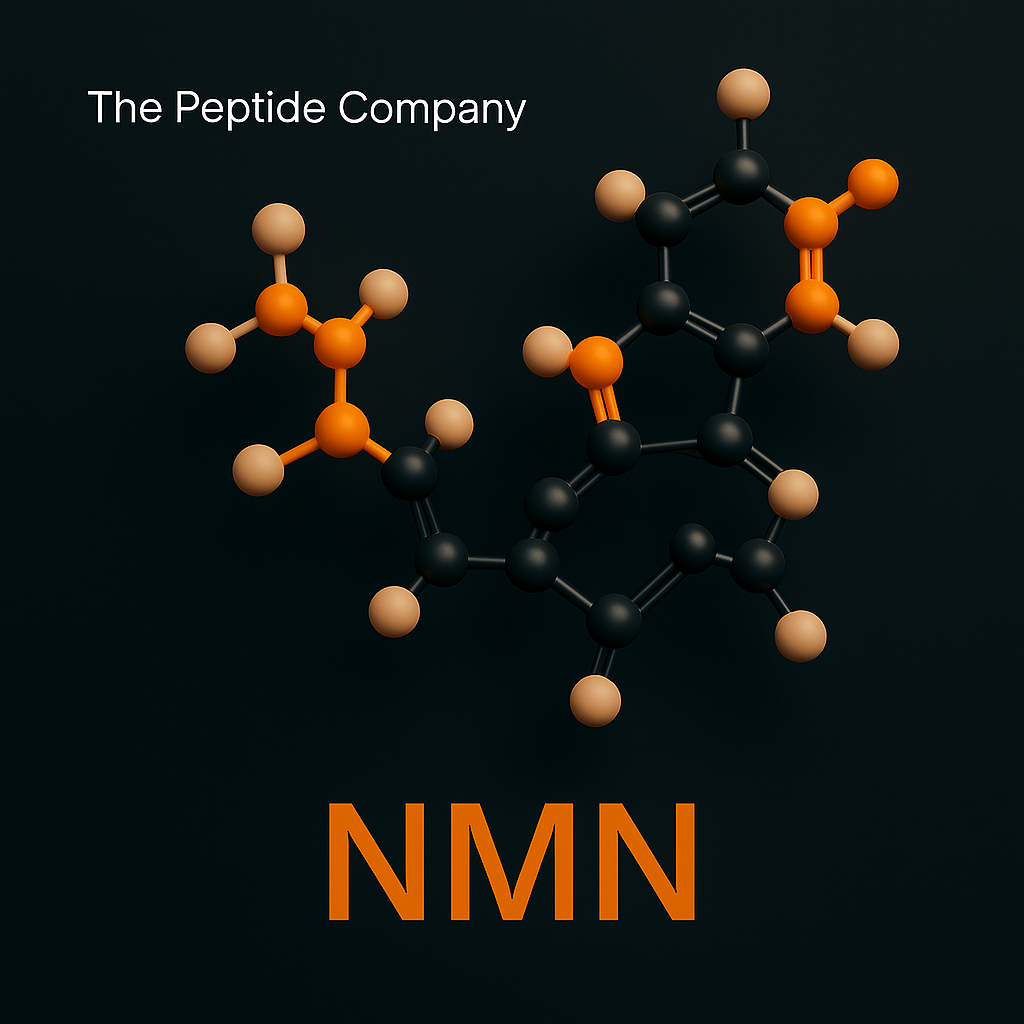
NMN (nicotinamide mononucleotide) is a central intermediate in the NAD⁺ salvage pathway and is widely studied for its role in cellular metabolism, mitochondrial redox cycles, genomic maintenance, and energy signaling. As a precursor to NAD⁺, NMN significantly influences sirtuin activity, DNA repair processes, metabolic adaptation, and mitochondrial function.
NAD⁺ Metabolism and the Salvage Pathway
NMN is generated from nicotinamide via NAMPT, the rate‑limiting enzyme of the salvage pathway. NMN is then converted into NAD⁺ through NMNAT enzymes (NMNAT1, NMNAT2, NMNAT3), distributed across the nucleus, cytosol, and mitochondria. Research explores how NMN availability affects intracellular NAD⁺ pools, sirtuin consumption, PARP‑mediated DNA repair, redox homeostasis, and metabolic resilience.
Mitochondrial NAD⁺ Biology
Mitochondria require NAD⁺ for electron transfer chain (ETC) activity. NAD⁺ accepts electrons in the TCA cycle, feeds complex I through NADH, and enables ATP production. Research shows NMN-supported NAD⁺ levels influence mitochondrial biogenesis, mitophagy, redox balance, UPRmt (mitochondrial unfolded protein response), and maintenance of mitochondrial membrane potential.
Energy Metabolism and Redox Cycling
NAD⁺/NADH ratios are crucial for glycolysis, beta‑oxidation, oxidative phosphorylation, and metabolic flux. NMN research investigates how restored NAD⁺ pools regulate AMPK activity, influence metabolic efficiency, and maintain healthy redox cycling across different tissues.
Sirtuin Pathways
Sirtuins (SIRT1, SIRT2, SIRT3, SIRT6) are NAD⁺‑dependent deacetylases critical for gene expression, mitochondrial stability, stress adaptation, and chromatin regulation. Studies show that NMN availability can modulate sirtuin activity, impacting metabolic transcription, antioxidant defenses, genomic maintenance, and mitochondrial protein acetylation patterns.
DNA Repair and PARP Activity
PARP enzymes consume NAD⁺ in response to DNA damage. NMN-supported NAD⁺ pools may influence PARP activation, DNA strand repair efficiency, and cellular responses to oxidative stress. Excessive PARP activation depletes NAD⁺, making NAD⁺replenishment and salvage pathway dynamics essential to genomic maintenance.
Comparative Mechanistic Notes: NMN vs NR vs NAD⁺
NMN converts directly to NAD⁺ via NMNAT. NR (nicotinamide riboside) must first convert to NMN before entering this step. Exogenous NAD⁺ cannot directly cross membranes efficiently and must be broken down into NMN or NR precursors. Mechanistic studies evaluate differences in transporters, enzymatic conversion rates, and intracellular uptake among these compounds.
Cellular Stress, Autophagy, and AMPK
Research explores NMN’s involvement in AMPK activation, autophagic flux, mitochondrial quality control, antioxidant transcription, and metabolic stress adaptation. These pathways integrate NMN into mitochondrial resilience and cell‑protection models.
Summary
NMN is a critical NAD⁺ precursor examined for its roles in mitochondrial energy metabolism, redox cycling, genomic stability, sirtuin activity, and metabolic adaptation. Its central position in the salvage pathway makes it a key subject of modern mitochondrial, metabolic, and cellular‑repair research.
Educational & Research Disclaimer
This article is for educational and scientific research purposes only. No therapeutic claims or usage recommendations are provided. Compounds referenced are not approved for human use and are intended solely for controlled laboratory experimentation.
Nicotinamide mononucleotide (NMN) is a biochemical NAD⁺ precursor studied in laboratory models for its role in cellular metabolism, oxidative stress pathways, and mitochondrial function.
NMN is enzymatically converted into NAD⁺ through the salvage pathway. Researchers use it to explore how NAD⁺ fluctuations affect metabolism, DNA repair, mitochondrial respiration, and cellular stress responses.
No. NMN from The Peptide Company is strictly for laboratory and in-vitro research. It is not a drug, supplement, or consumer product.
Research includes mitochondrial bioenergetics, sirtuin activation, metabolic regulation, redox balance, cellular aging models, and oxidative stress biology.
In controlled laboratory environments, NMN is examined for its relationship with ATP production, mitochondrial efficiency, and NAD⁺-dependent enzymatic activity.
NMN is stored cool and protected from light. After reconstitution, it is handled under validated institutional laboratory protocols only.
No. NMN is not for human consumption or clinical application of any kind.
MOTS-c: The Mitochondrial-Encoded Peptide for Metabolic Regulation and Cellular Resilience
PMID: 25642957 — NAD⁺ metabolism, aging, and mitochondrial homeostasis
PMID: 29127247 — NMN and NAD⁺ salvage pathway in metabolic research
PMID: 26730458 — NAD⁺ precursors and mitochondrial function in experimental models
PMID: 31395777 — Redox regulation and sirtuin activity driven by NAD⁺ modulation
PMID: 23434792 — Cellular energy metabolism and NAD⁺ biosynthesis dynamics