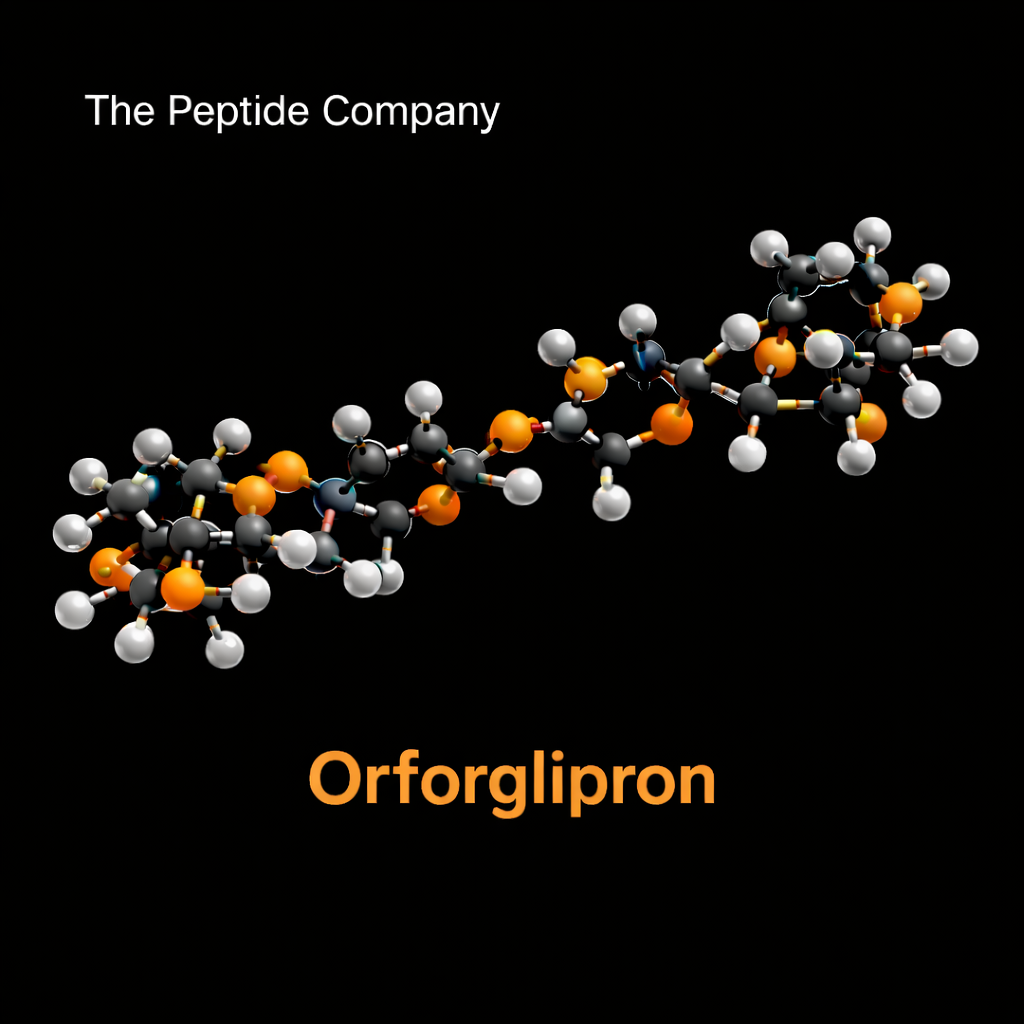
Abstract & Overview
Orforglipron is a synthetic, non-peptide small molecule designed to activate the glucagon-like peptide‑1 (GLP‑1) receptor through oral administration. Unlike traditional incretin agonists derived from peptide backbones, Orforglipron represents a chemically engineered approach to engaging class B G‑protein–coupled receptors. Research surrounding this compound focuses on its ability to modulate metabolic signaling pathways involved in appetite regulation, glucose homeostasis, and energy balance. Orforglipron serves as a key model for investigating non‑peptide incretin receptor activation and the expanding role of small molecules in metabolic biology.
Molecular Classification and Pharmacology
Orforglipron belongs to the category of orally bioavailable small‑molecule receptor agonists. Structurally distinct from peptide incretins, it does not rely on amino acid sequences or peptide folding for receptor engagement. Its chemical architecture is optimized for gastrointestinal stability and systemic absorption. From a pharmacological perspective, Orforglipron demonstrates that GLP‑1 receptor activation can be achieved through non‑peptide ligand binding, challenging historical assumptions that peptide structure is required for effective incretin signaling.
Mechanism of Action
The mechanism of Orforglipron centers on direct activation of the GLP‑1 receptor, a class B GPCR involved in metabolic regulation. Upon receptor binding, Orforglipron stimulates Gs protein signaling, leading to increased intracellular cyclic adenosine monophosphate (cAMP) levels and downstream activation of protein kinase A (PKA). This signaling cascade influences transcriptional activity, metabolic enzyme regulation, and neural signaling pathways associated with appetite and energy balance. Due to its small‑molecule nature, Orforglipron may exhibit signaling bias, selectively engaging specific intracellular pathways relative to peptide-based agonists.
Gut–Brain Axis and Central Metabolic Signaling
GLP‑1 receptors are expressed throughout the gastrointestinal tract and central nervous system, forming a critical communication network known as the gut–brain axis. Orforglipron’s oral bioavailability allows it to participate in this signaling network by influencing peripheral and central receptor populations. Research models indicate that GLP‑1 receptor activation within this axis contributes to appetite regulation, satiety signaling, and coordinated metabolic responses, positioning Orforglipron as a useful compound for studying neuro‑metabolic integration.
Comparative Insights: Small Molecules vs Peptide GLP‑1 Agonists
Compared to peptide‑based GLP‑1 agonists, Orforglipron differs in molecular weight, stability, and synthesis. Peptide agonists require structural modifications to resist enzymatic degradation, whereas Orforglipron’s chemical composition inherently resists proteolysis. While peptide agonists more closely mimic endogenous GLP‑1, small‑molecule agonists such as Orforglipron offer alternative receptor engagement profiles and manufacturing efficiencies. These distinctions provide valuable comparative insight into how molecular format influences receptor signaling and biological outcomes.
Research Findings and Experimental Models
Preclinical and early research models investigating Orforglipron focus on receptor affinity, signaling kinetics, and metabolic pathway modulation. Experimental data highlight its capacity to activate canonical GLP‑1 signaling pathways while maintaining oral stability. Ongoing studies evaluate its effects on metabolic biomarkers, receptor desensitization dynamics, and long‑term signaling behavior. Orforglipron is frequently used as a reference compound in research exploring non‑peptide incretin agonism.
Implications for Metabolic Research
Orforglipron’s development has broader implications for metabolic and endocrine research. It demonstrates that small molecules can effectively target class B GPCRs traditionally dominated by peptide ligands. This has encouraged expanded investigation into oral incretin modulators, receptor signaling bias, and alternative approaches to metabolic pathway regulation. Orforglipron also serves as a conceptual bridge between peptide‑based biology and chemically driven pharmacological design.
Summary
Orforglipron represents a significant advancement in incretin research as a non‑peptide, orally active GLP‑1 receptor agonist. Its ability to engage metabolic signaling pathways without peptide structure underscores the importance of receptor biology over molecular format alone. As a research compound, Orforglipron continues to inform studies on gut–brain signaling, metabolic regulation, and the future design of small‑molecule GPCR agonists.
Educational & Research Disclaimer
This document is provided for educational and scientific research purposes only. No medical, therapeutic, or usage claims are made. Compounds discussed are not approved for human use and are intended solely for controlled laboratory and academic investigation.
Orforglipron is a synthetic, non-peptide small-molecule compound designed to activate the glucagon-like peptide-1 (GLP-1) receptor through oral administration. It is studied as part of incretin pathway and metabolic signaling research.
No. Orforglipron is not a peptide. Unlike traditional GLP-1 receptor agonists derived from peptide backbones, Orforglipron is a chemically engineered small molecule.
Orforglipron is orally bioavailable and does not rely on peptide structures, which are typically degraded in the gastrointestinal tract. This makes it a model compound for studying non-peptide GPCR activation.
Research focuses on GLP-1 receptor signaling, incretin pathway modulation, appetite-related signaling, glucose regulation pathways, and broader metabolic signaling networks.
In research models, Orforglipron binds to and activates the GLP-1 receptor through a small-molecule interaction, triggering downstream G-protein–coupled receptor (GPCR) signaling cascades.
No. Orforglipron referenced in this context is discussed strictly for research and educational purposes. It is not intended for human consumption.
Orforglipron represents a shift toward non-peptide incretin receptor agonists, offering insights into oral GPCR modulation and expanding the scope of small-molecule metabolic research.
Metabolic biology, endocrinology research, GPCR pharmacology, incretin signaling, and small-molecule drug design studies.
Mazdutide : Dual GLP‑1 and Glucagon Receptor Activation in Metabolic and Lipid Regulation Research
Apelin : APJ Receptor Signaling, Cardiovascular Regulation, and Metabolic Research Pathways