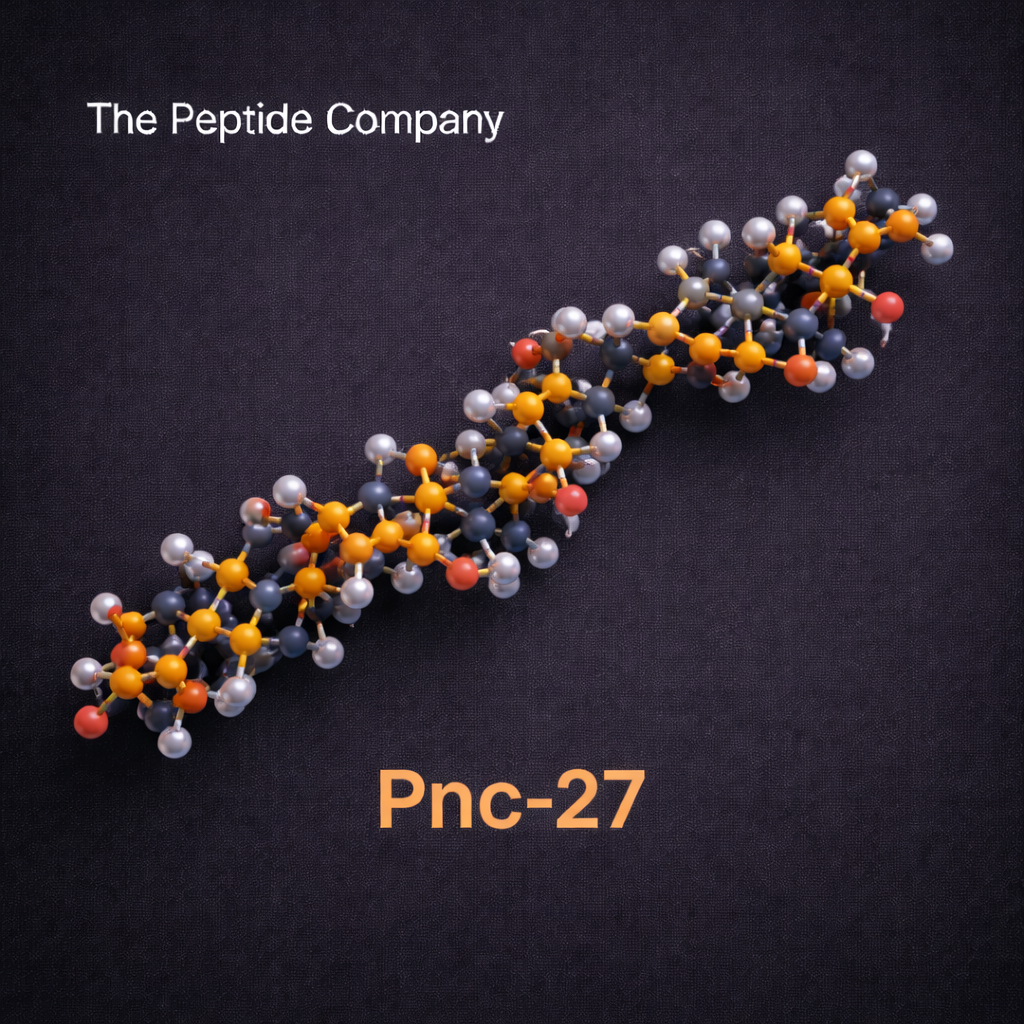
Abstract & Overview
Pnc‑27 is a synthetic peptide derived from the HDM‑2 binding domain of the tumor suppressor protein p53. It has been developed as a research model for studying tumor‑selective cytotoxicity and membrane disruption mechanisms. Unlike conventional cytotoxic agents that rely on intracellular signaling pathways, Pnc‑27 exerts its activity by binding directly to HDM‑2 expressed on the plasma membranes of malignant cells. This interaction leads to the formation of transmembrane pores, causing rapid cell lysis and necrotic death in tumor cells, while sparing normal cells that lack surface HDM‑2 expression.
Molecular Pharmacology
Pnc‑27 is composed of 32 amino acids and incorporates two functional domains: an HDM‑2 binding region derived from the N‑terminal sequence of p53, and a membrane‑penetrating peptide segment designed to facilitate pore formation. The full sequence is H‑Lys‑Leu‑Phe‑Gln‑Leu‑Thr‑Thr‑Gly‑Gln‑Ile‑Lys‑Lys‑Leu‑Leu‑Leu‑Gly‑Gly‑Ala‑Gly‑Arg‑Leu‑Leu‑Asp‑Leu‑NH₂. This configuration enables Pnc‑27 to selectively interact with membrane‑localized HDM‑2 and disrupt lipid bilayer integrity. The peptide’s amphipathic structure supports its ability to self‑assemble into pore‑forming oligomers within tumor cell membranes.
Mechanism of Action
The defining feature of Pnc‑27’s mechanism lies in its tumor cell selectivity. In malignant cells expressing membrane‑bound HDM‑2, Pnc‑27 binds to the receptor and integrates into the lipid bilayer, forming transmembrane channels. This results in uncontrolled ion flux, loss of membrane potential, and rapid necrosis. In contrast, healthy cells with cytosolic (non‑membrane) HDM‑2 remain unaffected. Experimental data suggest that Pnc‑27’s pore formation process is independent of apoptosis and caspase activation, distinguishing it from classical apoptotic peptides.
Selectivity and Research Findings
Studies in cellular and xenograft models demonstrate that Pnc‑27 selectively induces cytolysis in a variety of cancer cell types, including pancreatic, breast, colon, and melanoma lines. Confocal microscopy and electrophysiological analyses confirm the peptide’s ability to form nanometer‑scale pores in tumor cell membranes, resulting in rapid cell swelling and rupture. Importantly, non‑malignant cells, fibroblasts, and epithelial lines exhibit negligible sensitivity to Pnc‑27 exposure, reinforcing its receptor‑specific mechanism of action. This selectivity underscores its utility as a tool for investigating HDM‑2–related membrane dynamics in cancer biology.
Mitochondrial and Membrane Effects
In addition to its plasma membrane activity, Pnc‑27 indirectly affects mitochondrial stability in tumor cells. Following pore formation and membrane depolarization, secondary mitochondrial effects include cytochrome c release, oxidative stress, and ATP depletion. This cascade contributes to enhanced reactive oxygen species (ROS) generation and cellular energy failure. However, these downstream effects occur as a consequence of primary membrane disruption rather than direct mitochondrial targeting. Fluorescence spectroscopy and electron microscopy studies reveal structural perturbations in lipid raft regions rich in cholesterol and sphingolipids, which may facilitate the peptide’s insertion and aggregation behavior.
Comparative Analysis
Pnc‑27 shares mechanistic similarities with other cytolytic peptides such as PNC‑28 and LL‑37, yet differs in its receptor specificity and structural organization. PNC‑28, another p53‑derived peptide, displays broader cytolytic activity but reduced tumor selectivity. LL‑37, a cathelicidin antimicrobial peptide, similarly induces membrane disruption but targets microbial membranes rather than tumor cell surfaces. When compared to Adipotide, which acts via vascular apoptosis, Pnc‑27’s direct membrane permeabilization represents a distinct, rapid‑onset form of peptide‑mediated cytotoxicity. This distinction makes it a useful candidate for comparative research in membrane biophysics and peptide design.
Summary
Pnc‑27 exemplifies a new class of tumor‑selective, membrane‑active peptides designed to exploit differential receptor expression between malignant and normal cells. Its HDM‑2 binding specificity, coupled with potent membrane‑disruptive properties, makes it a powerful experimental model for studying pore formation, membrane mechanics, and targeted cytotoxicity. Continued research into Pnc‑27 provides insights into peptide‑based anti‑cancer strategies and the molecular interplay between membrane receptors, lipid microdomains, and programmed cell death mechanisms.
Educational & Research Disclaimer
This article is for educational and scientific research purposes only. No therapeutic claims or usage recommendations are provided. Compounds referenced are not approved for human use and are intended solely for controlled laboratory experimentation.
Pnc-27 is a synthetic chimeric peptide built from the HDM-2–binding region of the tumor suppressor protein p53 fused to a membrane-penetrating sequence. It was designed as a research tool to study HDM-2–targeted, cancer-selective cytotoxicity.
In vitro and preclinical studies suggest that Pnc-27 binds to HDM-2 located in cancer cell membranes, assembles into transmembrane pores, and induces rapid necrotic cell death through membranolysis and leakage of intracellular contents, rather than classical apoptosis.
Many transformed cell lines express elevated levels of HDM-2 in their plasma membranes, while matched non-transformed cells show little or no membrane-bound HDM-2. Experimental data indicate that Pnc-27 preferentially lyses cells with high membrane HDM-2, sparing cells that lack this surface expression, which explains its reported selectivity in laboratory systems.
Pnc-27 has been evaluated in a variety of human cancer cell lines (including pancreatic, melanoma, breast, and cervical cancer models) and in mouse tumor models, where it has been used to probe HDM-2–targeted membrane disruption and tumor necrosis.
Unlike small-molecule HDM-2 antagonists that primarily restore intracellular p53 signaling and trigger apoptosis, Pnc-27 appears to act mainly at the cell surface by binding membrane HDM-2 and forming cytotoxic pores, resulting in necrotic cell death and additional effects on mitochondrial integrity in some models.
No. Pnc-27 is an experimental research peptide only. Current data come from in vitro experiments and preclinical studies; it is not approved by regulatory agencies for human or veterinary use, diagnosis, treatment, or prevention of any disease.
Pnc-27 should be presented strictly as an HDM-2–targeting research peptide used to investigate membrane pore formation, cancer-cell selectivity, and related mechanisms in controlled laboratory settings, with clear disclaimers that it is not for human or animal administration or any therapeutic application.
GHRP‑2 : Pituitary Axis Modulation, Ghrelin Receptor Activation, and Cellular Recovery Research