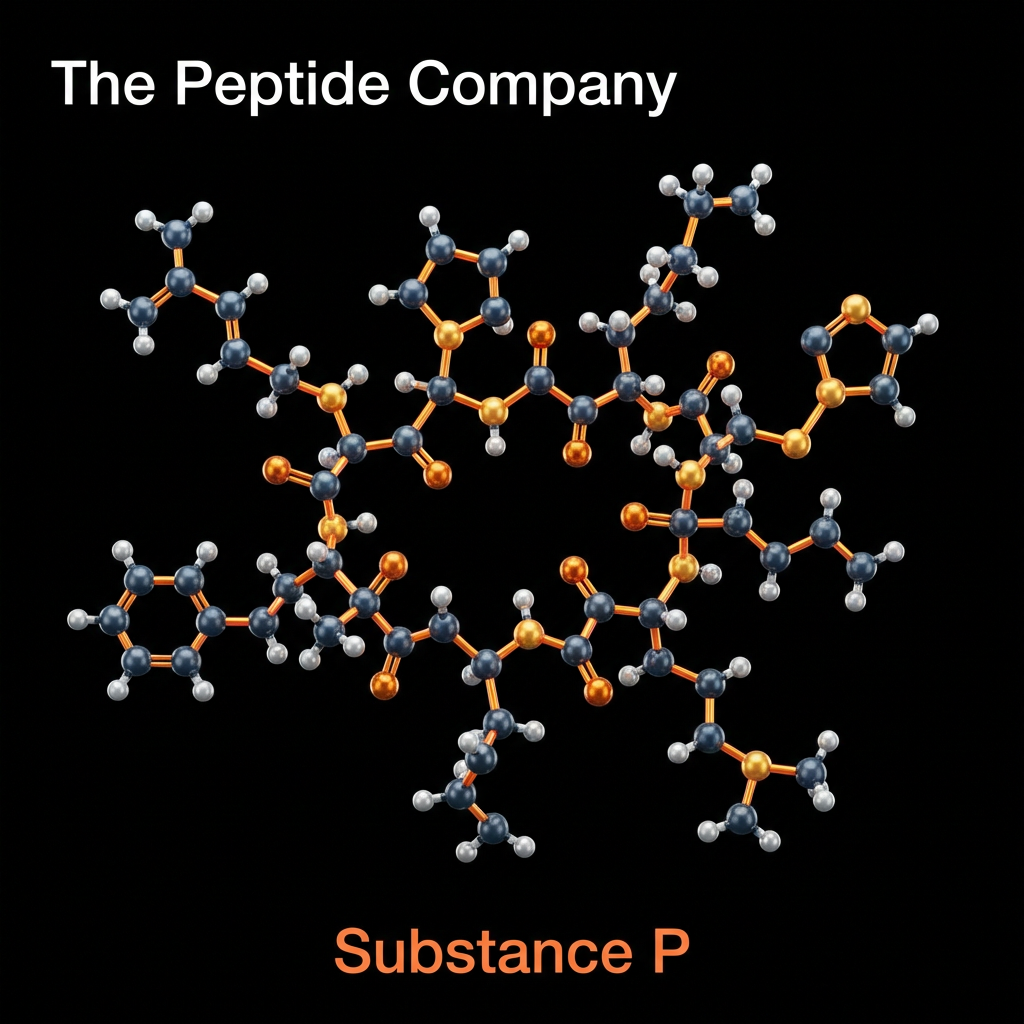
Substance P (SP) is an 11-amino acid neuropeptide belonging to the tachykinin family, widely distributed throughout the central and peripheral nervous systems. First identified in 1931 by von Euler and Gaddum, it holds the distinction of being the first neuropeptide to be discovered. In contemporary research, Substance P is extensively studied as a primary mediator of nociception (pain transmission) and neurogenic inflammation. It functions principally through high-affinity binding to the Neurokinin-1 (NK1) receptor, a G-protein coupled receptor (GPCR) found on neurons, immune cells, and endothelial tissues.
The peptide sequence of Substance P (Arg-Pro-Lys-Pro-Gln-Gln-Phe-Phe-Gly-Leu-Met-NH2) is highly conserved across mammalian species, reflecting its critical evolutionary role in survival mechanisms. Beyond its classical function as a neurotransmitter of pain signals in the dorsal horn of the spinal cord, Substance P is now recognized as a ubiquitous modulator of physiological stress responses, immune system regulation, and emotional behavior. Research models involving NK1 receptor antagonism have provided profound insights into the peptide’s involvement in conditions ranging from chronic pain and inflammatory diseases to depression and anxiety disorders.
MOLECULAR STRUCTURE AND NEURO KININ RECEPTOR FAMILY
Substance P is encoded by the preprotachykinin-A (TAC1) gene and is synthesized as a larger precursor protein that undergoes post-translational cleavage. It belongs to the tachykinin peptide family, which also includes Neurokinin A and Neurokinin B. These peptides share a common C-terminal sequence, Phe-X-Gly-Leu-Met-NH2, which is essential for receptor activation. However, Substance P exhibits unique selectivity for the NK1 receptor, distinguishing its biological profile from other family members that prefer NK2 or NK3 receptors.
Structural biology research has elucidated that the C-terminal region of Substance P is responsible for receptor binding and activation, while the N-terminal sequence determines metabolic stability and specificity. The amidation of the C-terminus is critical for biological potency; non-amidated analogs show drastically reduced affinity for the NK1 receptor. This structure-activity relationship is a key focus in the development of synthetic NK1 antagonists designed to block Substance P signaling without interfering with other tachykinin pathways.
The most well-characterized role of Substance P is its function as a nociceptive neurotransmitter. It is synthesized in the cell bodies of dorsal root ganglion (DRG) neurons and transported to both central and peripheral nerve terminals. In response to noxious stimuli—such as intense heat, mechanical pressure, or chemical irritants—Substance P is released into the dorsal horn of the spinal cord, where it acts synergistically with glutamate to transmit pain signals to the brain.
Research into chronic pain models has demonstrated that inhibiting Substance P signaling can attenuate central sensitization, the process by which the nervous system becomes hypersensitive to stimuli. This has led to extensive investigation of NK1 receptor antagonists as potential analgesics. Although early clinical trials faced challenges due to species-specific differences in receptor pharmacology, preclinical data continues to support the critical role of Substance P in the maintenance of neuropathic and inflammatory pain.
NEUROIMMUNE INTERACTIONS AND INFLAMMATORY REGULATION
Substance P serves as a vital bridge between the nervous and immune systems. NK1 receptors are expressed on a wide array of immune cells, including macrophages, mast cells, T-lymphocytes, and dendritic cells. The release of Substance P from peripheral nerve endings can directly activate these cells, triggering the release of pro-inflammatory cytokines like IL-1β, IL-6, and TNF-α. This bi-directional communication is fundamental to the concept of neurogenic inflammation.
This neuroimmune axis is particularly relevant in research on stress-induced immune suppression and inflammatory disorders. By modulating cytokine profiles, Substance P can influence the progression of inflammatory responses. Experimental models have shown that NK1 receptor blockade can reduce the severity of inflammation in conditions like colitis and arthritis, highlighting the therapeutic potential of targeting this neuropeptide in autoimmune pathology.
NEUROGENIC INFLAMMATION AND WOUND HEALING RESEARCH
Neurogenic inflammation refers to the process where inflammatory symptoms—redness, swelling, and heat—are initiated by the release of neuropeptides from sensory nerves rather than by immune cells directly. Substance P is the primary mediator of this process. Upon release from peripheral nerve terminals, it causes vasodilation and plasma protein extravasation (leakage of fluid from blood vessels) by acting on endothelial cells.
Research in regenerative medicine is exploring the dual nature of Substance P. While its pro-inflammatory effects can be detrimental in chronic disease, its ability to stimulate cellular proliferation and angiogenesis is beneficial for tissue repair. Investigational therapies aim to harness its wound-healing properties—particularly in neuropathic ulcers and corneal injuries—while managing the inflammatory component.
SUBSTANCE P IN NEUROPSYCHIATRIC AND STRESS RESPONSE MODELS
Beyond the spinal cord and periphery, Substance P is highly concentrated in brain regions associated with emotional processing, such as the amygdala, hypothalamus, and hippocampus. It is a key component of the stress response system. Animal models of stress and anxiety consistently show elevated release of Substance P in these limbic areas, suggesting it functions as a “stress neurotransmitter.”
Although clinical translation for depression has been mixed, research
continues to investigate Substance P antagonists for specific stress-related disorders, including PTSD and alcohol dependence. The hypothesis is that blocking NK1 signaling may dampen the overactive stress circuitry without the sedative side effects common to benzodiazepines.
PHARMACOLOGICAL MODULATION: NK1 RECEPTOR ANTAGONISTS
The broad physiological role of Substance P has driven the development of NK1 receptor antagonists. The most successful clinical application to date is aprepitant, used to prevent chemotherapy-induced nausea and vomiting (CINV). Substance P is a major mediator of the vomiting reflex in the brainstem, and blocking its receptor effectively suppresses this response.
SOURCEDSTUDIES
Substance P is an 11-amino acid neuropeptide belonging to the tachykinin family, widely distributed throughout the central and peripheral nervous systems.
Substance P primarily binds to the neurokinin-1 (NK1) receptor, a G-protein coupled receptor expressed on neurons, immune cells, and endothelial tissues.
It is studied for its role in nociceptive transmission, neurogenic inflammation, neuroimmune signaling, and sensory neuron communication.
Substance P is present in the brain, spinal cord, peripheral sensory neurons, and various immune-related tissues.
It is widely researched as a neurotransmitter involved in transmitting nociceptive signals between peripheral nerves and central nervous system pathways.
Research indicates Substance P participates in neurogenic inflammation through interactions with immune cells and vascular signaling.
Substance P is a tachykinin neuropeptide composed of 11 amino acids with conserved structure across mammalian species.
It is investigated for its role in communication between the nervous system and immune signaling pathways.
Yes, Substance P is studied in both central nervous system signaling and peripheral sensory neuron pathways.
PMID: 7681072 — Distribution and function of Substance P in the nervous system
PMID: 7542593 — Neurokinin-1 receptor binding and Substance P signaling
PMID: 1374954 — Substance P and nociceptive transmission mechanisms
PMID: 1714860 — Tachykinins and neurogenic inflammation pathways
PMID: 7521983 — Substance P in neuroimmune communication
PMID: 1693883 — Sensory neuron release of Substance P
PMID: 8381513 — NK1 receptor pharmacology and signaling
PMID: 10844083 — Substance P in central nervous system signaling
PMID: 11877335 — Substance P and inflammatory mediator pathways
PMID: 15265877 — Neurokinin receptors and peptide neurotransmission
Cerebrolysin : Neurotrophic Peptide
Noopept : Neuropeptide Derived
Thymalin: Thymic Bioregulator Peptide, Immune Aging, and Epigenetic Control of Cellular Homeostasis
PE‑22‑28: Selective Neuropeptide Analog in Serotonergic and Stress‑Response Research