Abstract & Overview
Thymulin — also designated facteur thymique sérique (FTS) or serum thymic factor (STF) — is an endogenous nonapeptide hormone produced by two distinct epithelial populations within the thymus. First isolated and biochemically characterised by Bach and colleagues in 1977, thymulin occupies a unique position in immunobiology as the only known thymic hormone whose biological activity is absolutely contingent upon coordination with a divalent zinc ion (Zn²⁺). In the absence of zinc, the peptide exists as an inactive apo-form; zinc binding induces a conformational transition that confers full receptor-binding competence and downstream signalling capacity [1][2].
Thymulin’s primary role is the orchestration of T-lymphocyte maturation — both within the thymic microenvironment and at extrathymic peripheral sites. Beyond this canonical immunological function, thymulin operates as a bidirectional communicator between the immune system and the hypothalamic-pituitary-adrenal (HPA) axis, modulating the secretion of multiple adenohypophyseal hormones including luteinizing hormone (LH), follicle-stimulating hormone (FSH), growth hormone (GH), prolactin (PRL), thyroid-stimulating hormone (TSH), and adrenocorticotropic hormone (ACTH) [3][4]. Circulating thymulin levels peak in the early postnatal period and decline progressively with age, establishing the peptide as a quantitative biomarker of immunosenescence [5].
“Thymulin is not toxic and one may foresee its clinical use as one of the major immunoregulatory agents.” — Bach JF, Medical Oncology & Tumor Pharmacotherapy (1989) [6].
Molecular Identity and Structural Architecture
Thymulin is a nonapeptide with the amino acid sequence H-Pyr-Ala-Lys-Ser-Gln-Gly-Gly-Ser-Asn-OH, where Pyr denotes a pyroglutamate residue at the N-terminus — a cyclised form of glutamine that confers resistance to aminopeptidase degradation. The molecular formula is C₃₃H₅₄N₁₂O₁₅ with a molar mass of 858.86 g/mol (CAS: 63958-90-7; PubChem CID: 3085284). The serum half-life of thymulin is approximately 10.3 minutes, reflecting rapid clearance that necessitates continuous thymic secretion for sustained biological activity [5].
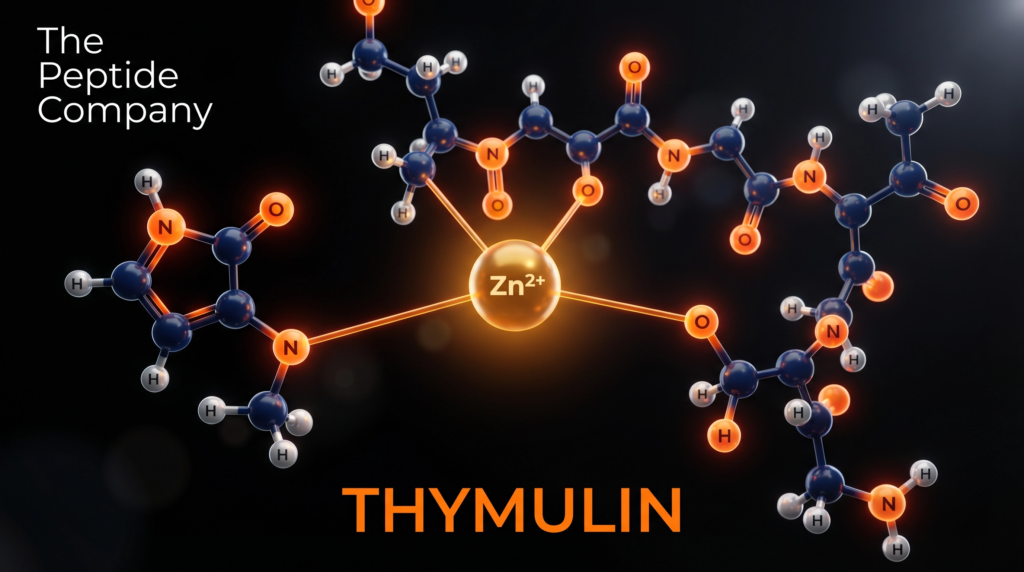
The zinc-binding site is formed by coordination chemistry involving the N-terminal pyroglutamate, the ε-amino group of lysine at position 3, and the hydroxyl groups of the two serine residues at positions 4 and 8. This tetradentate coordination geometry creates a stable 1:1 Zn:peptide metallopeptide complex. Critically, monoclonal antibody studies by Dardenne et al. demonstrated that the zinc-bound conformation exposes a distinct epitope not present on the apo-peptide, confirming that zinc binding is not merely stabilising but structurally transformative [2]. Chelation of zinc with EDTA or similar agents abolishes biological activity, while re-introduction of Zn²⁺ ions reconstitutes activity within minutes [1].
Thymulin secretion is regulated by a network of endocrine and paracrine signals including prolactin, growth hormone, interleukins IL-1α and IL-1β, and opioid peptides (β-endorphins and β-enkephalins). The peptide follows a circadian secretory rhythm, and physiologically elevated ACTH levels correlate positively with plasma thymulin concentrations, reflecting the deep integration of thymic endocrinology with the HPA axis [3].
Mechanistic Rationale: Zinc Activation and Receptor Signalling
Zinc-Dependent Activation and T-Cell Maturation
The Zn²⁺-bound metallopeptide form of thymulin is the sole biologically active species. Upon zinc coordination, the peptide adopts a compact conformation that enables high-affinity binding to surface receptors expressed on immature lymphoid precursor cells within the thymic cortex and medulla. Binding of thymulin to these receptors initiates intracellular signalling cascades that prime T-cell precursors for progressive maturation steps, culminating in the expression of key surface phenotypic markers: CD90 (Thy-1), CD3, CD4, and CD8 [7].
Thymulin exerts both intra- and extrathymic effects on T-cell differentiation. Within the thymus, it acts in concert with thymic epithelial cells and their cytokine networks to orchestrate the sequential developmental programme from double-negative (CD4⁻CD8⁻) precursors through double-positive (CD4⁺CD8⁺) intermediates to mature single-positive (CD4⁺ or CD8⁺) T-cells. Extrathymically, thymulin can act on peripheral lymphoid precursors, partially restoring T-cell function in thymectomised animals — a property that distinguishes it from thymosin α₁ and thymopoietin, which lack significant extrathymic activity [7][8].
Thymulin also enhances natural killer (NK) cell cytotoxic activity, broadening its immunomodulatory profile beyond the T-cell lineage. Deficits in both Zn²⁺ and thymulin bioactivity have been documented in patients with Crohn’s disease and acute lymphoblastic leukaemia, suggesting that zinc-thymulin insufficiency may contribute to the immune dysregulation characteristic of these conditions [8].
Neuroendocrine Axis: Thymus-Pituitary Communication
Thymulin acts directly on anterior pituitary cells to modulate the secretion of multiple adenohypophyseal hormones. Research by Brown et al. demonstrated that thymulin stimulates LH release, and that co-incubation with gonadotropin-releasing hormone (GnRH) produces a synergistic effect on LH secretion and an additive effect on FSH release [3]. These interactions are mediated through second messenger pathways — specifically, accumulation of cyclic AMP (cAMP) and cyclic GMP (cGMP) following thymulin exposure in pituitary cell preparations — pointing to a receptor-mediated process whose molecular identity remains under investigation [3].
The neuroendocrine effects of thymulin are age-dependent: responsiveness of pituitary cells to thymulin declines in aged animals, paralleling the age-related fall in circulating thymulin levels. This bidirectional relationship — wherein thymulin modulates pituitary output while pituitary hormones (GH, PRL, ACTH) in turn regulate thymulin secretion — positions the peptide as a central node in the neuroendocrine-immune communication network [4][5].
Anti-Inflammatory and Cytokine Regulatory Mechanisms
A growing body of preclinical evidence positions thymulin as a potent negative regulator of inflammatory signalling. The metallopeptide suppresses the production of key pro-inflammatory cytokines — including interleukin-1β (IL-1β), interleukin-6 (IL-6), tumour necrosis factor-α (TNF-α), and interferon-γ (IFN-γ) — while concurrently elevating the counter-regulatory cytokine interleukin-10 (IL-10). This dual action shifts the immune microenvironment toward a controlled, anti-inflammatory state rather than simply suppressing immune activity [9].
At the intracellular signalling level, thymulin dampens the activity of nuclear factor kappa-B (NF-κB) and p38 mitogen-activated protein kinase (p38 MAPK) — two transcriptional regulators central to inflammatory gene expression. Additionally, thymulin reduces the production of heat shock proteins HSP70 and HSP72, which are typically upregulated during cellular stress and inflammation, suggesting interference with the broader stress-response axis [10].
Neuroprotective Effects and the Peptide Analog of Thymulin (PAT)
Thymulin and its synthetic analog PAT (Peptide Analog of Thymulin) have demonstrated significant neuroprotective and analgesic properties in preclinical models. Astrocytes appear to be the primary CNS target for thymulin’s anti-inflammatory action. In models of intracerebroventricular endotoxin injection, thymulin-related peptide attenuated brain inflammation, reduced endotoxin-induced hyperalgesia, and restored near-normal levels of IL-6 and IL-1β across specific brain tissue regions [11].
In chronic inflammatory pain models, thymulin attenuated spinal neuroinflammation through suppression of spinal microglial activation — evidenced by reduced Iba-1 expression — and inhibition of p38 MAPK phosphorylation and TNF-α production in the spinal cord. These findings suggest that thymulin may interfere with central sensitisation mechanisms, offering a potential avenue for the treatment of neuropathic pain and neuroinflammatory conditions including rheumatoid arthritis and neurodegenerative disease [11][12].
Research Applications and Experimental Evidence
Immunosenescence and Age-Related Immune Decline
The progressive decline of thymulin with age is one of the most reproducible findings in thymic endocrinology. Circulating thymulin peaks in the early postnatal period (approximately 2 pg/mL in umbilical cord blood) and falls to near-undetectable levels by the sixth decade of life. This decline correlates with the involution of the thymus and the contraction of the naive T-cell repertoire — hallmarks of immunosenescence. Research models indicate that thymulin supplementation can partially restore T-cell differentiation capacity and NK cell activity in aged subjects, suggesting potential utility as an immunorestorative agent in the context of ageing [5][8].
Zinc Deficiency and Immune Dysfunction
Because thymulin activity is absolutely dependent on zinc bioavailability, zinc deficiency states produce a functional thymulin insufficiency even when peptide synthesis is intact. Studies in zinc-deficient rodent models demonstrate impaired T-cell differentiation, reduced NK cell activity, and elevated susceptibility to infection — all of which can be partially reversed by zinc supplementation. Clinically relevant zinc deficiency states — including malnutrition, inflammatory bowel disease, and anorexia nervosa — are associated with significantly reduced thymulin bioactivity, providing a mechanistic link between nutritional zinc status and adaptive immune competence [1][13].
Tissue-Specific Protective Effects
Thymulin has demonstrated protective effects across multiple organ systems in preclinical research. In chemically induced diabetes models, thymulin suppressed hyperglycaemia and preserved pancreatic β-cell integrity by reducing the accumulation of pro-inflammatory cytokines that drive β-cell destruction. In nephrotoxicity models, thymulin mitigated renal damage via downregulation of inflammatory cascades and stress-response proteins. In colitis models, thymulin reduced colonic tissue inflammation by suppressing IL-1β, IL-6, TNF-α, and IFN-γ production. In pulmonary hypertension models, thymulin decreased IL-6 expression and reduced p38 MAPK activation, suggesting interference with cytokine-driven vascular remodelling [7].
Autoimmune and Oncological Research Models
Thymulin’s immunoregulatory properties have been investigated in models of autoimmune disease and haematological malignancy. In rheumatoid arthritis models, thymulin-related peptides attenuated joint inflammation and reduced pro-inflammatory cytokine burden. In models of acute lymphoblastic leukaemia, thymulin deficiency correlates with impaired immune surveillance, raising the possibility that thymulin restoration could support host anti-tumour immunity. Immunostimulatory effects have also been documented in animals infected with immunodeficiency virus and experimental encephalomyelitis [8][14].
Thymulin vs. Other Major Thymic Hormones: Comparative Profile
| Parameter | Thymulin (FTS) | Thymosin α₁ | Thymopoietin |
| Structure | Nonapeptide (9 AA) | 28-AA peptide | 49-AA peptide |
| Zinc Dependency | Absolute (metallopeptide) | None | None |
| Primary Action | T-cell differentiation | T-cell maturation/NK | T-cell differentiation |
| Extrathymic Activity | Yes (peripheral) | Yes | Limited |
| Neuroendocrine Effects | Extensive (HPA axis) | Limited | Not established |
| Anti-inflammatory | Yes (NF-κB, p38 MAPK) | Yes (moderate) | Limited data |
Pharmacological Considerations
Thymulin is a naturally occurring endogenous hormone available in synthetic form. Its small molecular size (858.86 Da) and nonapeptide structure render it amenable to solid-phase peptide synthesis with high purity. The serum half-life of approximately 10.3 minutes reflects rapid renal clearance, which has driven interest in developing more stable analogs such as PAT (Peptide Analog of Thymulin) with modified termini to resist peptidase degradation. The zinc-dependence of thymulin activity introduces an important pharmacological variable: the bioavailability of zinc at the site of action directly determines the proportion of peptide that exists in the active metallopeptide form [5][6].
Preclinical toxicology studies have not identified significant adverse effects associated with thymulin administration. Bach’s 1989 review noted the peptide’s favourable safety profile and proposed it as a candidate immunoregulatory therapeutic. Despite this, thymulin preparations have not advanced to formal clinical trials, a gap attributed in part to the complexity of zinc co-administration requirements and the availability of alternative immunomodulatory agents. The synthetic PAT analog, which retains the core immunomodulatory and neuroprotective properties while offering improved stability, represents the most clinically advanced thymulin-related compound currently under investigation [12][14].
Conclusion
Thymulin stands as one of the most structurally and functionally distinctive peptides in the thymic endocrine repertoire. Its absolute dependence on zinc for biological activity — a property unique among thymic hormones — creates a sophisticated regulatory checkpoint that couples immune function to systemic zinc homeostasis. As the primary orchestrator of T-lymphocyte maturation, thymulin governs the generation of the adaptive immune repertoire from early postnatal life through adulthood, with its progressive decline serving as a molecular signature of immunosenescence.
Beyond its canonical immunological role, thymulin’s extensive neuroendocrine interactions — modulating pituitary hormone secretion and responding to HPA axis signals — position it as a central integrator of immune-endocrine communication. Its anti-inflammatory properties, mediated through suppression of NF-κB and p38 MAPK pathways and elevation of IL-10, together with the neuroprotective analgesic effects demonstrated by PAT, open compelling research avenues in neuroinflammation, chronic pain, autoimmunity, and age-related immune decline. As synthetic analogs with improved pharmacokinetic profiles continue to be developed, thymulin’s translational potential as an immunorestorative and neuroprotective research compound remains substantial.
References
[1] Bach JF, Dardenne M, Pleau JM, Rosa J. Biochemical characterisation of a serum thymic factor. Nature. 1977;266(5597):55–7. doi:10.1038/266055a0. PMID: 300146.
[2] Dardenne M, Savino W, Berrih S, Bach JF. A zinc-dependent epitope on the molecule of thymulin, a thymic hormone. Proc Natl Acad Sci USA. 1985;82(20):7035–8. doi:10.1073/pnas.82.20.7035.
[3] Brown OA, Sosa YE, Dardenne M, Pléau JM, Goya RG. Studies on the gonadotropin-releasing activity of thymulin: changes with age. J Gerontol A Biol Sci Med Sci. 2000;55(4):B170–6. doi:10.1093/gerona/55.4.b170. PMID: 10811143.
[4] Brown OA, Sosa YE, Bolognani F, Goya RG. Thymulin stimulates prolactin and thyrotropin release in an age-related manner. Mech Ageing Dev. 1998;104(3):249–62. doi:10.1016/s0047-6374(98)00072-4. PMID: 9818729.
[5] Besman M, Zambrowicz A, Matwiejczyk M. Review of Thymic Peptides and Hormones: From Their Properties to Clinical Application. Int J Pept Res Ther. 2024;31:10. doi:10.1007/s10989-024-10666-y.
[6] Bach JF. Thymulin, a zinc-dependent hormone. Med Oncol Tumor Pharmacother. 1989;6(1):25–9. doi:10.1007/BF02985220. PMID: 2657247.
[7] Reggiani PC, Schwerdt JI, Console GM, Roggero EA, Dardenne M, Goya RG. Physiology and therapeutic potential of the thymic peptide thymulin. Curr Pharm Des. 2014;20(29):4690–6. doi:10.2174/1381612820666140130211157. PMID: 24588820.
[8] Dardenne M, Pléau JM, Nabarra B, et al. Contribution of zinc and other metals to the biological activity of the serum thymic factor. Proc Natl Acad Sci USA. 1982;79(17):5370–3. doi:10.1073/pnas.79.17.5370. PMID: 6957870.
[9] Haddad JJ, Saade NE, Safieh-Garabedian B. Thymulin: An emerging anti-inflammatory molecule. Curr Med Chem Anti-Inflamm Anti-Allergy Agents. 2005;4(3):333–8.
[10] Lunin SM, Khrenov MO, Novoselova TV, et al. Thymulin, a thymic peptide, prevents the overproduction of pro-inflammatory cytokines and heat shock protein Hsp70 in inflammation-bearing mice. Immunol Invest. 2008;37(8):858–70. doi:10.1080/08820130802447629. PMID: 18991101.
[11] Safieh-Garabedian B, Jabbur SJ, Dardenne M, Saadé NE. Thymulin related peptide attenuates inflammation in the brain induced by intracerebroventricular endotoxin injection. Neuropharmacology. 2011;60(2–3):496–504. doi:10.1016/j.neuropharm.2010.11.004. PMID: 21059360.
[12] Nasseri B, Zaringhalam J, Daniali S, et al. Thymulin treatment attenuates inflammatory pain by modulating spinal cellular and molecular signaling pathways. Int Immunopharmacol. 2019;70:225–234. doi:10.1016/j.intimp.2019.02.042. PMID: 30851702.
[13] Wade S, Bleiberg F, Mossé A, et al. Thymulin (Zn-facteur thymique sérique) activity in anorexia nervosa patients. Am J Clin Nutr. 1985;42(2):275–80. doi:10.1093/ajcn/42.2.275. PMID: 3927699.
[14] Dardenne M, Saade N, Safieh-Garabedian B. Role of thymulin or its analogue as a new analgesic molecule. Ann NY Acad Sci. 2006;1088:153–63. doi:10.1196/annals.1366.006. PMID: 17192563.
Disclaimer: This article is intended strictly for research and educational review purposes. Thymulin is an endogenous peptide hormone under preclinical investigation and has not been approved for human therapeutic use by any regulatory authority. All referenced studies were conducted in in vitro or preclinical (rodent) models unless otherwise stated. This document does not constitute medical advice and should not be used to guide clinical practice or personal health decisions.
thepeptidecompany.xyz | Research Division
Thymulin is a thymic peptide studied for its role in immune system regulation, T-cell activity, and neuroendocrine signaling pathways.
It is commonly studied for its involvement in thymus-derived immune signaling, inflammatory modulation, and cellular immune communication.
Research suggests Thymulin influences T-lymphocyte differentiation, immune signaling pathways, and cytokine-related activity in experimental models.
Thymulin is studied in pathways related to immune regulation, neuroendocrine communication, inflammatory signaling, and thymic function.
It serves as a biomarker and signaling peptide associated with thymic activity and immune system maturation.
Yes, experimental models also investigate its role in neuroendocrine interactions, stress signaling, and age-related thymic changes.
PMID:
6607412 — Thymulin structure and thymic hormone characterization
6140038 — Thymulin and T-cell differentiation research
6225511 — Immunoregulatory functions of thymulin
2951376 — Neuroendocrine interactions involving thymulin
8397102 — Thymulin and cytokine signaling pathways
10849509 — Thymic peptides and immune modulation
12745733 — Thymulin activity in inflammatory research
17026784 — Age-related thymic signaling and thymulin research
RELATED SEARCHES:
Thymosin Alpha-1 (Tα1): Immune Resilience and the Science of Thymic Restoration
Thymalin: Thymic Bioregulator Peptide, Immune Aging, and Epigenetic Control of Cellular Homeostasis
KPV: The Anti-Inflammatory Tripeptide and Cellular Repair Mechanism
LL-37: The Antimicrobial Peptide and Innate Immunity Blueprint
GHRP‑2 : Pituitary Axis Modulation, Ghrelin Receptor Activation, and Cellular Recovery Research