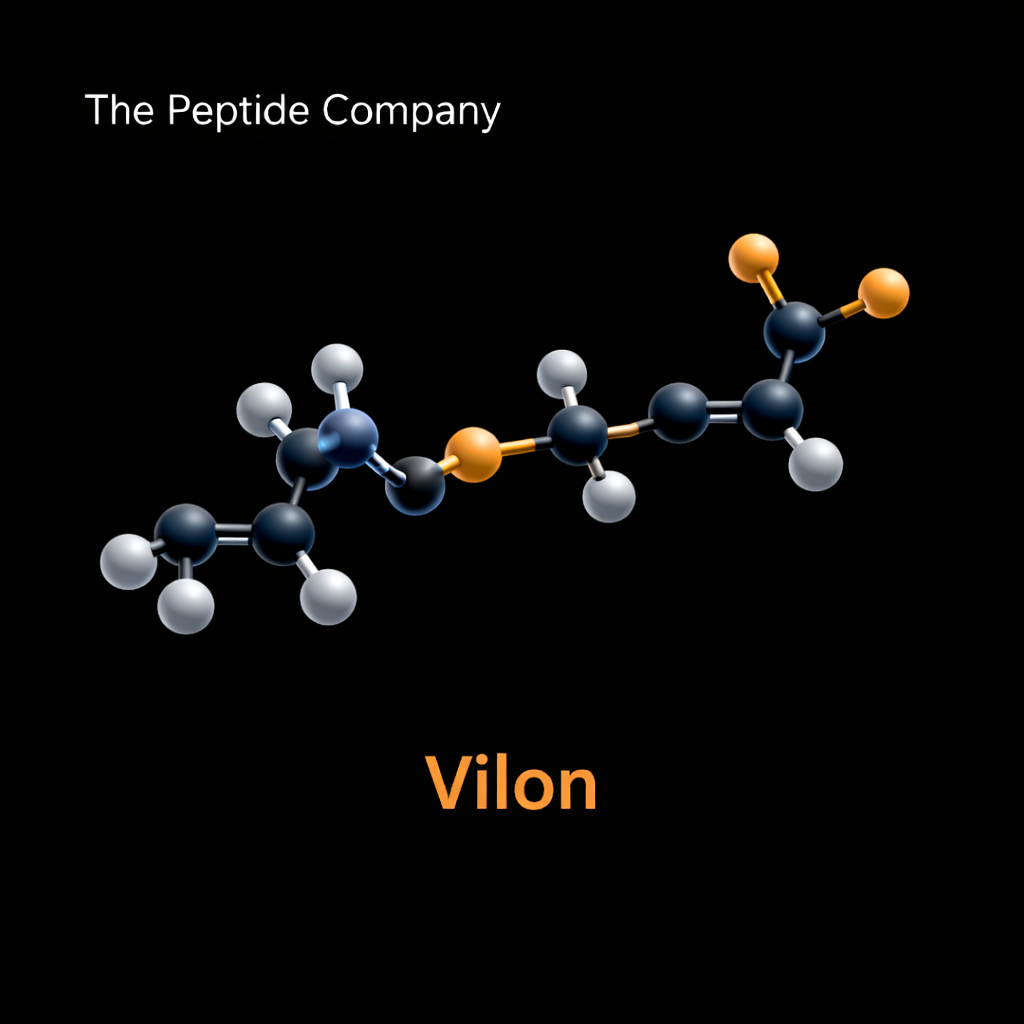
Abstract & Overview
Vilon is a short, synthetic bioregulatory peptide classified within the cytomedin family and recognized for its broad, non–tissue-restricted regulatory activity. Unlike organ-specific bioregulators that target individual tissues, Vilon functions as a universal regulator of cellular differentiation, proliferation, and repair. Research on Vilon focuses on its ability to normalize cell cycle dynamics, stabilize gene expression patterns, and support systemic homeostasis through epigenetic mechanisms. As a model compound, Vilon plays a central role in studies of aging biology, regenerative signaling, and coordinated tissue regulation.
Cytomedins and Universal Bioregulation
Cytomedins are short regulatory peptides, typically consisting of two to four amino acids, that exert targeted control over gene expression within specific cell populations. While many cytomedins demonstrate strict tissue specificity, Vilon is distinguished by its universal activity across epithelial, immune, and connective tissues. This broad action is attributed to its interaction with conserved genomic and chromatin-associated regulatory mechanisms rather than tissue-specific receptors. Vilon therefore serves as a foundational peptide for understanding systemic bioregulation.
Molecular Classification and Structure
Vilon is composed of a minimal amino acid sequence optimized for genomic interaction rather than receptor binding. Its low molecular weight facilitates cellular and nuclear access in experimental systems. Unlike classical signaling peptides, Vilon does not rely on surface receptor activation or second-messenger cascades. Instead, its structure supports direct modulation of transcriptional and translational processes, positioning it within a distinct class of gene-regulatory peptides.
Mechanism of Action: Cell Cycle and Gene Regulation
The primary mechanism attributed to Vilon involves normalization of cell cycle progression through modulation of gene expression associated with proliferation, differentiation, and apoptosis. Vilon has been shown in experimental models to influence transcription factors governing G1/S and G2/M checkpoints, thereby supporting balanced cellular turnover. By stabilizing RNA synthesis and protein translation, Vilon contributes to maintenance of functional tissue architecture and prevention of dysregulated growth.
Epigenetic Modulation and Chromatin Dynamics
Vilon’s regulatory activity extends to epigenetic control mechanisms, including chromatin remodeling and histone modification. Research indicates that Vilon influences chromatin accessibility, enabling appropriate transcriptional responses to physiological stress and repair demands. Through these epigenetic effects, Vilon supports long-term stability of gene expression patterns rather than transient signaling changes, a hallmark of bioregulatory peptides.
Role in Cellular Differentiation and Regeneration
Studies of Vilon demonstrate its involvement in guiding stem and progenitor cell differentiation toward mature, functional phenotypes. By regulating lineage-specific gene expression programs, Vilon contributes to coordinated tissue regeneration and repair. This effect is particularly relevant in aging models, where dysregulated differentiation and impaired regenerative capacity contribute to tissue decline.
Integration With Tissue-Specific Bioregulators
Vilon is frequently examined in conjunction with organ-specific bioregulators such as Thymalin, Pancragen, Cardiogen, Bronchogen, and ProstaMax. While these peptides exert localized regulatory effects, Vilon provides systemic coordination, ensuring that tissue-specific repair processes occur within a balanced cellular environment. This integrative role underscores its designation as a universal bioregulator.
Implications for Aging and Systemic Homeostasis
Age-associated decline is characterized by disrupted cell cycle control, genomic instability, and impaired intercellular communication. Vilon’s ability to normalize gene expression and cellular turnover positions it as a valuable research tool for studying mechanisms of aging and systemic deterioration. Experimental findings suggest that Vilon contributes to improved tissue resilience and functional stability in aging biological systems.
Research Findings and Experimental Evidence
Experimental investigations involving Vilon have reported normalization of cellular proliferation rates, enhanced regenerative signaling, and reduced markers of cellular stress. In vitro studies demonstrate increased RNA synthesis and balanced protein expression across multiple cell types. In vivo models further support Vilon’s role in maintaining tissue organization and functional coherence under stress or age-related decline.
Comparative Context: Vilon vs Tissue-Specific Cytomedins
Compared to tissue-specific cytomedins, Vilon exhibits broader regulatory scope but reduced organotropism. Whereas peptides such as Thymalin or Pancragen target discrete tissues, Vilon influences conserved cellular processes shared across systems. This distinction allows researchers to dissect hierarchical levels of bioregulation, from universal genomic control to tissue-level specialization.
Limitations and Open Research Questions
Despite extensive experimental study, questions remain regarding Vilon’s precise molecular targets, long-term epigenetic effects, and interaction with other regulatory peptides. Further research is required to map its genomic binding sites and to clarify how universal bioregulation interfaces with tissue-specific signaling networks. These uncertainties continue to drive investigation into Vilon’s full biological scope.
Summary
Vilon represents a central universal bioregulator peptide that provides insight into systemic control of cell cycle dynamics, epigenetic regulation, and tissue homeostasis. Through genomic-level modulation, Vilon supports coordinated cellular function across multiple tissues, making it a foundational compound in bioregulator and aging research. Its study continues to inform broader understanding of peptide-based regulation of biological systems.
Educational & Research Disclaimer
This document is provided for educational and scientific research purposes only. No medical, therapeutic, or usage claims are made. Vilon and related compounds are not approved for human use and are intended solely for controlled laboratory and academic investigation.
Vilon is a synthetic short peptide (Lys–Glu) derived from thymus-related research and classified as a peptide bioregulator in the “cytomedin” family of regulatory compounds.
Laboratory work has examined Vilon’s effects on chromatin structure, gene expression, and immune-related signaling, especially in aging models and lymphocyte cultures.
Studies on cultured lymphocytes from older donors report that Vilon can promote decondensation of certain chromatin regions and support reactivation of ribosomal and other genes linked to cellular function.
Mouse splenocyte experiments suggest that Vilon can increase interleukin-2 (IL-2) mRNA synthesis in a concentration- and time-dependent manner, indicating potential immunomodulatory activity at the gene-expression level.
Preclinical work in tumor-bearing mice and small clinical studies in older oncology patients have explored Vilon as an adjunct to conventional therapy, focusing on survival, immune markers, and treatment tolerance. These data are limited and exploratory.
No. Vilon is not approved as a drug by major regulatory agencies. Available data are primarily experimental and come largely from Russian and Eastern European research groups.
Vilon should be presented strictly as a laboratory research molecule with clear language stating that it is not intended for human or veterinary use, and not for diagnosis, treatment, cure, or prevention of any disease.
FOXO4-DRI : Targeting Cellular Senescence Through p53–FOXO4 Disruption and Senolytic Research
GHRP‑2 : Pituitary Axis Modulation, Ghrelin Receptor Activation, and Cellular Recovery Research
B7‑33 : Relaxin Pathway Modulation and Fibrosis Regulation in Cellular Signaling Research
Cardiogen: Short Peptide Bioregulator for Cardiac and Myocardial Tissue Research