Abstract & Overview
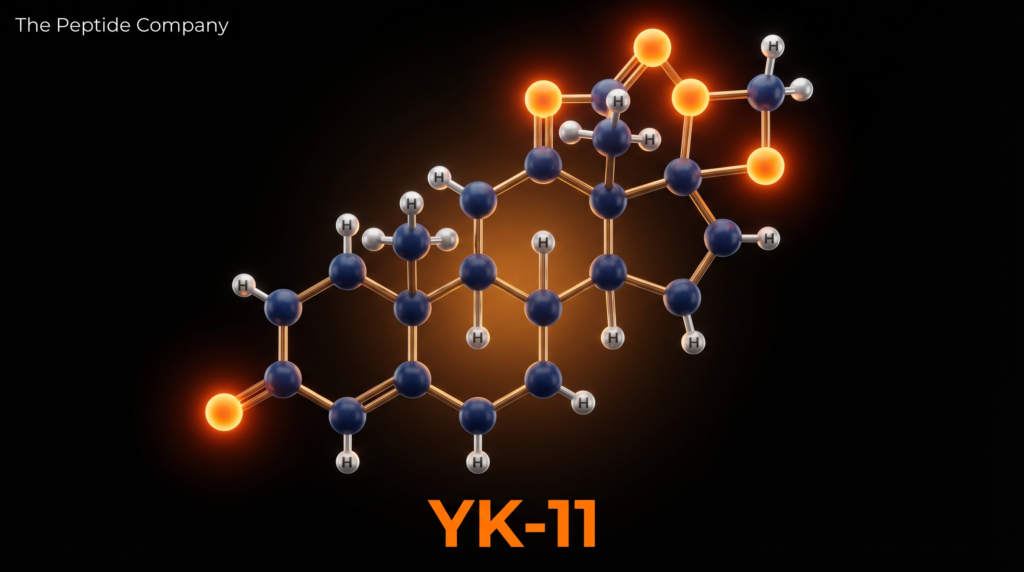
YK-11 — also designated Myostine and formally named (17α,20E)-17,20-[(1-methoxyethylidene)bis(oxy)]-3-oxo-19-norpregna-4,20-diene-21-carboxylic acid methyl ester — is a synthetic steroidal selective androgen receptor modulator (SARM) first characterised by Kanno et al. at Toho University, Japan, in 2011 [1]. Unlike the majority of SARMs, which are non-steroidal small molecules, YK-11 is built upon a modified 19-norpregnane steroid scaffold, placing it in a structurally distinct subclass of androgen receptor (AR) modulators. Its molecular formula is C₂₅H₃₄O₆ with a molar mass of 430.54 g/mol (CAS: 1370003-76-1; PubChem CID: 119058028).
YK-11 operates through a dual pharmacological mechanism that distinguishes it from both classical anabolic steroids and conventional non-steroidal SARMs. First, it functions as a gene-selective partial agonist of the androgen receptor, binding the receptor’s ligand-binding domain without inducing the N-terminal/C-terminal (N/C) interaction required for full AR transactivation, thereby activating a distinct subset of androgen-responsive genes [1][2]. Second, and uniquely, YK-11 induces the expression of follistatin (FST) in skeletal muscle cells — an effect not observed with dihydrotestosterone (DHT) — which in turn neutralises myostatin (GDF-8), the primary endogenous inhibitor of skeletal muscle mass [2]. This dual mechanism positions YK-11 as both a SARM and a functional myostatin inhibitor.
“YK11 is a selective androgen receptor modulator (SARM), which activates AR without the N/C interaction… YK11 treatment of C2C12 cells, but not DHT, induced the expression of follistatin (Fst), and the YK11-mediated myogenic differentiation was reversed by anti-Fst antibody. These results suggest that the induction of Fst is important for the anabolic effect of YK11.” — Kanno Y et al., Biol Pharm Bull (2013) [2].
Preclinical research has further demonstrated that YK-11 promotes osteoblastic proliferation and differentiation via Akt signalling [3], attenuates sepsis-induced muscle wasting and reduces mortality in animal models through suppression of the TLR4/NF-κB/TGF-β inflammatory cascade [4], and has been investigated for its effects on hippocampal function and oxidative stress [5][6]. YK-11 has not received regulatory approval for human use and is classified as a designer drug and research compound.
Molecular Identity and Structural Architecture
YK-11 is built upon a 19-norpregnane steroidal backbone — the same core scaffold found in progestins such as norethisterone — with several key structural modifications that confer its unique pharmacological profile. The most distinctive feature is the 17α,20-ketal group: a (1-methoxyethylidene)bis(oxy) moiety bridging positions 17 and 20 of the steroid nucleus. This ketal group is the primary determinant of YK-11’s selective AR binding profile, as it sterically prevents the receptor from adopting the conformation required for the N/C interaction. The molecule also bears a 3-oxo-4-ene configuration (a conjugated enone in ring A, common to androgenic steroids) and a methyl ester at C-21, which contributes to oral bioavailability and metabolic stability [1].
The steroidal nature of YK-11 is pharmacologically significant. Most SARMs in research use — including RAD-140, LGD-4033, and Ostarine — are non-steroidal compounds that bind the AR through entirely different chemical scaffolds. YK-11’s steroid scaffold allows it to interact with the AR in a manner that more closely resembles natural androgens, yet the 17α,20-ketal modification fundamentally alters the receptor’s conformational response, producing a gene-selective activation pattern distinct from both testosterone and DHT. The compound is orally bioavailable with an estimated half-life of approximately 6 to 8 hours, necessitating multiple daily administrations in research protocols [1][2].
Mechanistic Rationale: Dual Pathway Anabolic Activity
Androgen Receptor Partial Agonism and Gene-Selective Activation
Upon cellular uptake, YK-11 binds to the ligand-binding domain (LBD/AF2) of the androgen receptor with high affinity. In contrast to full AR agonists such as DHT and testosterone, YK-11 binding does not induce the physical interaction between the receptor’s N-terminal activation function 1 (NTD/AF1) and its ligand-binding domain activation function 2 (LBD/AF2) — a conformational event known as the N/C interaction that is required for maximal AR transactivation. The absence of this interaction means that YK-11 activates only a subset of androgen-responsive genes, producing a tissue-selective anabolic profile that theoretically spares androgenic side effects associated with full AR agonism [1].
Despite being a partial agonist, YK-11 demonstrated greater anabolic potency than DHT in C2C12 murine myoblast cells in vitro, as measured by the induction of key myogenic regulatory factors (MRFs). Specifically, YK-11 produced more robust upregulation of MyoD (myoblast determination protein 1), Myf5 (myogenic factor 5), and myogenin than equimolar concentrations of DHT, suggesting that the gene-selective activation pattern of YK-11 may be particularly well-suited to the myogenic differentiation programme [2].
Follistatin Induction and Myostatin Inhibition
The most pharmacologically distinctive feature of YK-11 is its capacity to induce follistatin (FST) expression in skeletal muscle cells — an effect that is entirely absent with DHT treatment. Follistatin is a secreted glycoprotein that functions as a high-affinity binding protein and functional antagonist for myostatin (growth differentiation factor 8, GDF-8) and activin, both members of the TGF-β superfamily. Myostatin is the primary endogenous brake on skeletal muscle hypertrophy: it signals through the ActRIIB/ALK4-5 receptor complex to activate Smad2/3 transcription factors, which suppress the expression of myogenic genes and promote muscle protein catabolism [2][4].
By inducing follistatin expression via AR activation, YK-11 effectively removes this myostatin-mediated inhibitory constraint on muscle growth. Follistatin binds myostatin with high affinity, preventing it from engaging its receptor complex and thereby disinhibiting the myogenic programme. The essential role of follistatin in YK-11’s anabolic mechanism was definitively demonstrated by Kanno et al. (2013): treatment of C2C12 myoblasts with an anti-follistatin antibody completely reversed YK-11-mediated myogenic differentiation, confirming that follistatin induction is not merely coincidental but is mechanistically required for YK-11’s anabolic effects [2]. This makes YK-11 the only known compound that achieves myostatin inhibition indirectly through AR-mediated follistatin transcription.
TLR4/NF-κB/TGF-β Pathway and Anti-Inflammatory Myoprotection
Lee et al. (2021) investigated YK-11 in a murine model of gram-negative bacterial sepsis, a condition characterised by severe muscle wasting driven by inflammatory cytokine cascades. In septic mice, myostatin protein levels were markedly elevated in skeletal muscle, accompanied by increases in NF-κB, p-FOXO3a, p-Smad2, myogenin, and MyoD — a pattern consistent with catabolic muscle remodelling under inflammatory stress. YK-11 treatment inhibited myostatin expression, which in turn suppressed the TLR4/NF-κB/TGF-β signalling cascade, reducing pro-inflammatory cytokine levels and organ damage markers in the bloodstream and major organs [4].
Critically, YK-11 treatment significantly decreased the mortality rate of septic mice, establishing a functional link between myostatin inhibition, inflammatory resolution, and survival outcomes. These findings suggest that YK-11’s myoprotective effects extend beyond anabolic signalling to encompass a broader anti-inflammatory mechanism, positioning it as a potential research tool for conditions characterised by inflammatory muscle wasting, including cachexia, sarcopenia, and critical illness myopathy [4].
Osteogenic Activity via Akt Signalling
Beyond skeletal muscle, YK-11 has demonstrated significant osteogenic activity in preclinical models. Yatsu et al. (2018) demonstrated that YK-11 treatment accelerated cell proliferation and mineralisation in MC3T3-E1 mouse osteoblast cells, with upregulation of osteoblast-specific differentiation markers including osteoprotegerin (OPG) and osteocalcin. These effects were attenuated by AR antagonist treatment, confirming AR-dependence. The mechanistic basis for YK-11’s osteogenic activity was identified as non-genomic AR signalling: YK-11 increased phosphorylated Akt (p-Akt) protein levels in osteoblasts, activating the PI3K/Akt pathway that is a key regulator of androgen-mediated osteoblast differentiation [3].
A 2024 in vivo study further confirmed YK-11’s osteogenic potential, demonstrating that it promoted the osteogenic differentiation of bone marrow-derived mesenchymal stem cells (BMSCs) and facilitated the repair of cranial bone defects in rats via AR activation. These findings suggest that YK-11’s anabolic effects may extend to the skeletal system, potentially offering research utility in models of osteoporosis, bone fracture healing, and androgen deficiency-related bone loss [3][7].
Research Applications and Experimental Evidence
Muscle Hypertrophy and Myogenic Differentiation Models
YK-11’s primary research application has been in the study of myogenic differentiation and skeletal muscle hypertrophy. The C2C12 murine myoblast cell line has served as the principal in vitro model system, with YK-11 consistently demonstrating superior induction of MRFs (MyoD, Myf5, myogenin) compared to DHT. The compound’s unique capacity to simultaneously activate AR and induce follistatin expression makes it a valuable tool for dissecting the relative contributions of direct AR signalling versus myostatin pathway disinhibition to anabolic outcomes in muscle research [1][2].
Muscle Wasting and Cachexia Models
The sepsis study by Lee et al. (2021) established YK-11 as a research tool for investigating inflammatory muscle wasting. Its dual capacity to inhibit myostatin and suppress NF-κB-driven inflammatory signalling makes it particularly relevant to cachexia research, where both anabolic resistance and systemic inflammation contribute to muscle loss. Future research directions may include investigation in cancer cachexia, HIV-associated wasting, and glucocorticoid-induced myopathy models [4].
Bone Biology and Osteoporosis Research
YK-11’s osteogenic activity via Akt signalling and its in vivo bone defect repair data position it as a research candidate for androgen-deficiency-related osteoporosis models. The compound’s ability to promote osteoblast proliferation, mineralisation, and expression of OPG (which inhibits osteoclastogenesis) suggests a dual anabolic/anti-resorptive bone profile that warrants further investigation in ovariectomised and orchidectomised animal models [3][7].
YK-11 vs. Other SARMs and Anabolic Agents: Comparative Profile
| Parameter | YK-11 | RAD-140 (Testolone) | LGD-4033 (Ligandrol) |
| Scaffold | Steroidal (19-norpregnane) | Non-steroidal | Non-steroidal |
| AR Mechanism | Partial agonist (no N/C) | Full/partial agonist | Full agonist |
| Myostatin Inhibition | Yes (via follistatin) | No | No |
| Osteogenic Activity | Yes (Akt/AR pathway) | Partial (in vitro) | Limited data |
| Half-life (est.) | ~6–8 hours | ~60 hours | ~24–36 hours |
| Muscle Effect | Hypertrophy + differentiation | Hypertrophy | Hypertrophy + strength |
| Clinical Status | Research only (designer drug) | Research only | Phase I completed |
Safety Profile and Regulatory Status
YK-11 has not been evaluated in any formal human clinical trials, and its safety profile in humans remains entirely undetermined. The available preclinical data, while demonstrating anabolic and osteogenic activity in cell culture and animal models, do not provide sufficient information to characterise the compound’s toxicological profile, pharmacokinetics, or long-term effects in humans. The neurological research by Dahleh et al. (2023, 2024) identified concerning effects in hippocampal tissue, including induction of oxidative stress and mitochondrial dysfunction, which represent important safety signals requiring further investigation [5][6].
In 2022, Health Canada issued a public warning regarding SARMs including YK-11 (marketed as Myostine), stating that such products ‘are not authorized in Canada for any use and have not been reviewed by Health Canada for safety, effectiveness and quality,’ and that ‘the use of bodybuilding products that contain SARMs can pose serious health risks such as heart attack, stroke and liver damage.’ The long-term effects on the body remain unknown. YK-11 has been encountered as a novel designer drug and is not approved by any regulatory authority for human use [8].
Conclusion
YK-11 represents a structurally and mechanistically unique compound within the SARM research landscape. Its steroidal scaffold, gene-selective AR partial agonism, and — most distinctively — its capacity to induce follistatin expression and thereby functionally inhibit myostatin, distinguish it from all other known SARMs. The foundational work by Kanno et al. (2011, 2013) established the molecular basis for these effects, while subsequent studies have extended the compound’s research profile to include anti-inflammatory myoprotection in sepsis models, osteogenic activity via Akt signalling, and in vivo bone repair. The induction of MyoD, Myf5, and myogenin at levels exceeding those achieved by DHT, combined with follistatin-mediated myostatin neutralisation, provides a compelling mechanistic rationale for YK-11’s potent anabolic activity in preclinical muscle models.
However, the absence of any human clinical data, the neurological safety signals identified in hippocampal studies, and the complete lack of regulatory approval for human use represent significant limitations that preclude any clinical or personal use conclusions. YK-11 remains a valuable research tool for investigating the biology of the AR, the myostatin-follistatin axis, and the molecular mechanisms of muscle hypertrophy and bone formation. Future research priorities should include formal pharmacokinetic characterisation, comprehensive toxicological profiling, and investigation of tissue selectivity in vivo to fully evaluate the compound’s research potential and safety boundaries.
References
[1] Kanno Y, Hikosaka R, Zhang SY, et al. (17α,20E)-17,20-[(1-methoxyethylidene)bis(oxy)]-3-oxo-19-norpregna-4,20-diene-21-carboxylic acid methyl ester (YK11) is a partial agonist of the androgen receptor. Biol Pharm Bull. 2011;34(3):318–323. doi:10.1248/bpb.34.318. PMID: 21372378.
[2] Kanno Y, Ota R, Someya K, et al. Selective androgen receptor modulator, YK11, regulates myogenic differentiation of C2C12 myoblasts by follistatin expression. Biol Pharm Bull. 2013;36(9):1460–5. doi:10.1248/bpb.b13-00231. PMID: 23995658.
[3] Yatsu T, Kusakabe T, Kato K, et al. Selective androgen receptor modulator, YK11, up-regulates osteoblastic proliferation and differentiation in MC3T3-E1 cells. Biol Pharm Bull. 2018;41(3):394–398. doi:10.1248/bpb.b17-00748. PMID: 29491216.
[4] Lee SJ, Gharbi A, Shin JE, et al. Myostatin inhibitor YK11 as a preventative health supplement for bacterial sepsis. Biochem Biophys Res Commun. 2021;543:1–7. doi:10.1016/j.bbrc.2021.01.030. PMID: 33588136.
[5] Dahleh MMM, Bortolotto VC, Guerra GP, et al. YK11 induces oxidative stress and mitochondrial dysfunction in hippocampus: the interplay between a selective androgen receptor modulator (SARM) and exercise. J Steroid Biochem Mol Biol. 2023;233:106364. doi:10.1016/j.jsbmb.2023.106364. PMID: 37468001.
[6] Dahleh MMM, Bortolotto VC, Boeira SP, et al. From gains to gaps? How selective androgen receptor modulator (SARM) YK11 impacts hippocampal function: in silico, in vivo, and ex vivo perspectives. Chem Biol Interact. 2024;394:110971. doi:10.1016/j.cbi.2024.110971. PMID: 38521455.
[7] Yatsu T, Kanno Y, et al. YK11 promotes osteogenic differentiation of BMSCs and repair of cranial bone defects in rats. Biochem Biophys Res Commun. 2024. doi:10.1016/j.bbrc.2024. PMID: 39660819.
[8] Health Canada. Unauthorized products may pose serious health risks (SARMs including YK-11/Myostine). Government of Canada. Published 2022-06-03. Retrieved 2026-01-15.
[9] Christiansen AR, Lipshultz LI, Hotaling JM, Pastuszak AW. Selective androgen receptor modulators: the future of androgen therapy? Transl Androl Urol. 2020;9(Suppl 2):S135–S148. doi:10.21037/tau.2019.11.02. PMID: 32257854.
[10] Singh R, Bhasin S, Braga M, et al. Regulation of myogenic differentiation by androgens: cross talk between androgen receptor/beta-catenin and follistatin/transforming growth factor-beta signaling pathways. Endocrinology. 2009;150(3):1259–68. doi:10.1210/en.2008-0858. PMID: 18948405.
Disclaimer: This article is intended strictly for research and educational review purposes. YK-11 is not approved for human use by any regulatory authority and has not undergone formal clinical trials. Health Canada and other regulatory bodies have issued warnings regarding the use of SARMs including YK-11. This document does not constitute medical advice, endorsement of any substance, or guidance for personal use. All referenced studies were conducted in preclinical (in vitro or animal) models unless otherwise stated.
thepeptidecompany.xyz | Research Division
YK-11 is a synthetic research compound studied for its interaction with androgen receptor signaling and myostatin-associated pathways in experimental models.
Research suggests YK-11 may influence follistatin expression and myostatin-related signaling, making it mechanistically distinct from conventional androgen receptor modulators.
It is commonly studied in pathways involving skeletal muscle signaling, androgen receptor activity, myostatin regulation, and cellular growth-related mechanisms.
Experimental studies have explored its potential relationship with follistatin expression, a protein associated with modulation of myostatin signaling pathways.
No, YK-11 is a synthetic small-molecule research compound and not a peptide.
YK-11 is commonly investigated in laboratory models related to muscle biology, anabolic signaling, androgen receptor interactions, and growth-regulation pathways.
PMID:
24100606 — YK-11 and androgen receptor signaling research
23686394 — Myostatin regulation and skeletal muscle pathways
20847754 — Follistatin expression and muscle growth signaling
19593427 — Androgen receptor modulators in experimental models
12874277 — Myostatin biology and muscle regulation mechanisms
17468483 — Skeletal muscle growth signaling pathways
29997364 — Selective androgen receptor modulator research overview
30523342 — Myostatin-associated anabolic pathway investigations
RELATED SEARCHES:
Follistatin: Myostatin-Regulated Pathways and Advanced Muscle Research
Myostatin (GDF-8): Muscle Growth Regulation, TGF-β Superfamily Signaling, and Anabolic Homeostasis
ACE‑031 : Myostatin Inhibition, Muscle Hypertrophy, and Regenerative Research
Activin A: TGF-β Superfamily Signaling, SMAD2/3 Pathway Regulation, and Muscle–Fibrosis Cross-Talk
IGF-1 Analogues: LR3 and DES Structural Variations and Receptor Binding in Research Models
Pnc‑27 : HDM‑2 Binding Peptide, Cancer Cell Selectivity, and Membrane Disruption Mechanisms